
-
[ July 16, 2012]
Harvard Gazette features Feng Fu’s work on social evolution
-
A study, led by Feng Fu, a former Ph.D. student in College of Engineering at Peking University and now a postdoctoral researcher at Harvard University, is recently featured in the prestigious Harvard Gazette (http://news.harvard.edu/gazette/story/2012/07/the-positives-of-playing-favorites/). Fu’s mathematical modeling finds that playing in-group favoritism is a winning strategy; it pays to love your friends, even though today’s comrades can turn into tomorrow’s enemies.
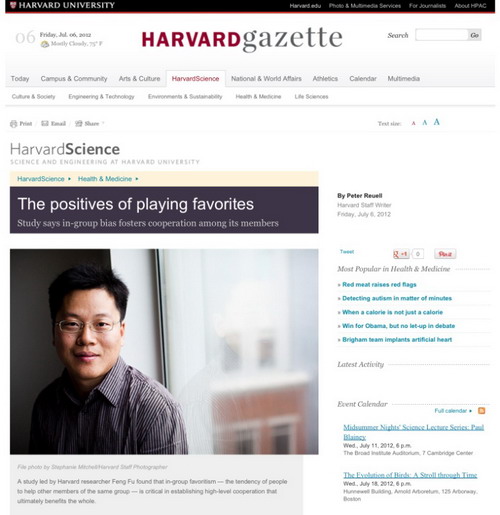 The evolution of cooperation has been a hot topic for years. In particular, explanatory mechanisms promoting and maintaining cooperative behavior in human societies have increasingly fascinated researchers from across different disciplines. Human interactions are exquisitely group structured, where individuals belong to social groups, such as companies, universities, and clubs. In-group favoritism describes the tendency of individuals to help members from their own group more than these from different groups. It is a central aspect of human social behavior. Thus, studying the emergence of in-group favoritism is crucial for understanding the ubiquity of human cooperation. The research on this topic, however, has been controversial. Prior work either relies on intergroup conflicts or pre-supposes preferential in-group helping.
In the study, Fu and colleagues proposed a novel mathematical model without invoking intergroup conflicts or competition and did not pre-suppose preferential in-group cooperation. Based on the combination of coalescent theory and evolutionary game theory, the study provided a general mathematical framework for studying “in-group/out-group” evolutionary dynamics. Armed with this framework and computer simulations, the current work predicated conditions under which in-group favoritism can evolve and also explored the situations where preferential out-group helping could arise.
Fu and colleagues stressed that although intergroup fights can promote in-group solidarity and cooperation, conflicts are not needed to maintain a successful group dynamic. More important is the flexibility in group identity, which allows individuals to “vote with their feet”: successful groups attract new members and successful strategies spawn imitators. All these circumstances help reinforce the tendency of individuals’ helping towards their group members.
Noteworthy, it is very promising to apply the mathematical framework to studying a wide variety of evolutionary dynamics in biological and social systems. For example, the evolutionary origin of homophily, a prominent open question in biosocial science, can be tackled using Fu’s new theory. As such, the analytical method presented in the paper will stimulate future theoretical and empirical research along this line.
The current study is the result of continued collaboration between the group of Professor Long Wang at Peking University and the lab led by Professor Martin Nowak at Harvard University. The paper is published online June 21 in Scientific Reports (http://www.nature.com/doifinder/10.1038/srep00460). Nature publishing group issued a press release summary for Fu’s work (http://www.nature.com/srep/about/press_releases/srep0612.html) and pitched it as one of the recent research highlights on its Asia-Pacific website (http://www.natureasia.com/en/research/index/highlight/id/1878/).
Previously, Harvard Gazette had covered the story about Feng Fu’s research on voluntary vaccination behavior and its impact on public health in July 2010 (http://news.harvard.edu/gazette/story/2010/07/vaccine-vacuum/).