
-
[ July 10, 2012]
University of South Florida researcher Yangxin Huang lectures on dynamic systems models
-
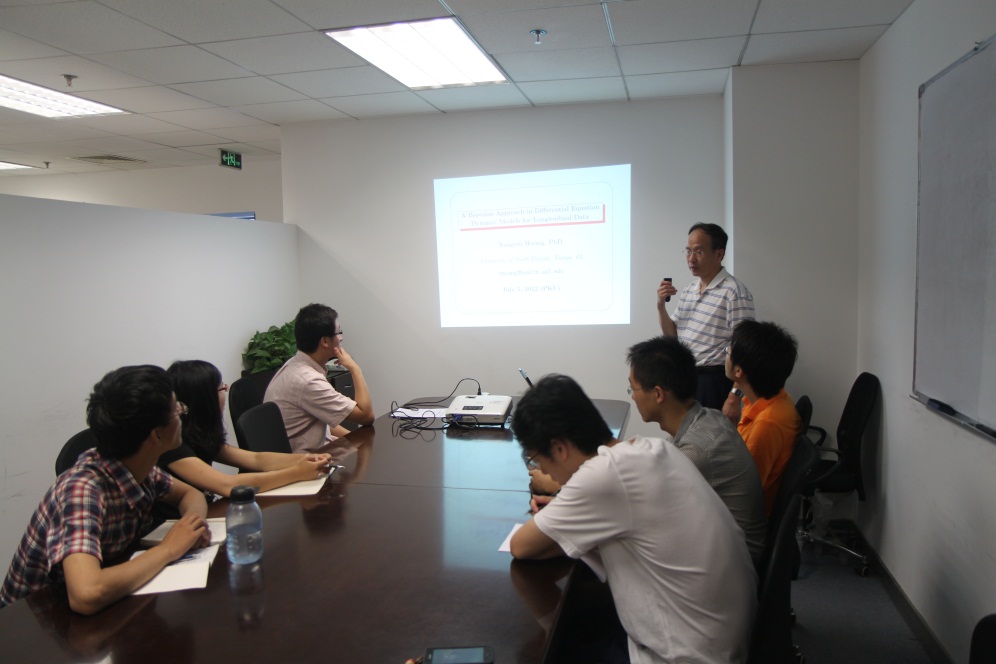
On July 5, University of South Florida Associate Professor Yangxin Huang gave a lecture about dynamic systems models to Department of Industrial Engineering and Management (IEM) faculty and students. Professor Leyuan Shi, department chair of IEM and many students attended the lecture.
Dr. Huang currently works in Department of Epidemiology and Biostatistics, College of Public Health at University of South Florida. He has been working in academic environments since 1986. His recent research interests focus on Bayesian methodology and Markov Chain Monte Carlo, Joint models and mixed-effects models for longitudinal and survival data, missing and measurement error data modeling and analysis.
In the lecture entitled “A Bayesian Approach in Differential Equation Dynamic Systems for Longitudinal HIV/AIDS Data”, Huang introduced his team’s study of dynamic models of HIV infection to help improve the knowledge in understanding the HIV pathogenesis and in evaluating antiretroviral therapies. In particular, they developed mechanism-based nonlinear Ordinary Differential Equation (ODE) models for characterizing long-term viral dynamics. The model integrated a variety of data including viral load, drug adherence, resistance, pharmacokinetics and baseline covariates into the inference and analysis. Furthermore, they applied the Bayesian nonlinear mixed-effects modeling to an AIDS clinical trial study. Results show that the mechanism-based dynamic model is powerful and effective to establish a relationship of antiviral response with drug adherence, drug susceptibility, pharmacokinetics and baseline covariates.
Before the lecture concludes, Huang pointed out that although his talk may focus mainly on HIV dynamics based on ODE system, the proposed methods and basic concept of longitudinal dynamic systems can be applied to other dynamic processes including engineering as long as they meet the relevant technical specifications.
A master student in IEM who attended the seminar told us, “The lecture has broadened my horizon. In my research I mainly focus on static models, while Huang introduced many different dynamic models. It expands my knowledge in this field. ”
“Dynamic systems are very common in our research and daily lives. I hope the seminar could open our students’ mind and provide some inspiration for their thinking.” said Dr. Xi Zhang, assistant professor of IEM who hosted the seminar.