
-
[ March 26, 2013]
Stanford Professor Roland N. Horne lectures about the future of oil
-
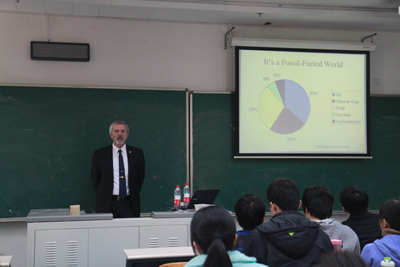 On March 22, invited by Associate Professor Bin Gong of the Department of Energy and Resources Engineering, Professor Roland N. Horne of Stanford University gave a lecture at Peking University about the future of oil 2013. Many PKU students attended the activity.
Roland N. Horne is now the Thomas Davies Barrow Professor of Earth Sciences in the Department of Energy Resources Engineering at Stanford University, and Director of the Stanford Geothermal Program. He was formerly the Chairman of the Department of Petroleum Engineering at Stanford from 1995 to 2006, while elected a member of the U.S. National Academy of Engineering in 2002. He is best known for his work in well test interpretation, production optimization, and tracer analysis of fractured reservoirs.
According to Horne, over recent years, oil, the world’s primary source of transportation fuel, has reached a “pinch point” between supply and demand – with the consequence that price has expanded rapidly to higher levels than ever seen before, then dropped precipitously. On the other hand, other energy resources that are renewable such as solar and wind has attracted increasing attention and effort. So what will the future of oil be?
In his lecture, Horne examined three aspects: (1) resources, (2) technology and (3) manpower. He pointed out that although oil production has been stable in the past decades, the discovery of reserve is reducing speed, and discovering and recovering increasingly larger amounts of hydrocarbon resources will require new technology, as well as a larger and a more sophisticated technical workforce. Secondly, the peak oil, gas and coal time will pass. Ultimately, the fossil fuel era will end, and the world must operate on renewable alternatives, to quench people’s increasing demand of energy in the distant future. Thirdly, the petroleum engineering discipline and petroleum education programs have crucial roles to play in meeting these new challenges.
The attending students showed great interests in Horne’s talk, and raised many questions such as how the structure of energy will change, what are the most advanced technologies, and what kind of talents the world would need in the future.