
-
[ May 13, 2013]
Progress made in astaxanthin bioengineering research
-
Professor Steven Chen of the PKU College of Engineering, in collaboration with Professor J.C. Huang of Kunming Institute of Botany of Chinese Academy of Sciences and Professor G. Sandmann of J.W. Goethe in Germany, has recently made important progress in astaxanthin bioengineering research. Their research article entitled “Metabolic engineering of tomato for high-yield production of astaxanthin” was published in the recent issue of Metabolic Engineering (17 (2013) 59-67).
Astaxanthin belongs to the family of ketocarotenoids and is considered the strongest antioxidant in nature; its antioxidant activity is 1000 times stronger than vitamin E, 200 times stronger than tea polyphenols, 150 times stronger than anthocyanins, 100 times stronger than lutein, 20 times stronger than lycopene, and 10 times stronger than β-carotene. Therefore astaxanthin is also called “super vitamin E”.
Because of its special molecular structure, astaxanthin not only possesses extraordinarily strong antioxidant activity but also possesses a number of medically important properties such as radio-resistance, anti-aging, anti-tumor and cardiovascular protection, etc. At present, astaxanthin has become a highly appealing product in the fields of clinical medicine, health, cosmetics as well as aquaculture.
However, the supply of naturally occurring astaxanthin is very limited. Humans can obtain only a trace amount of astaxanthin by eating certain seafoods such as shrimps, crabs and salmons. On earth, microalgae (particularly green microalgae) are the primary and best producer of astaxanthin. However, the technology for mass production of astaxanthin is still poorly developed, leading to an extremely high price of natural astaxanthin (e.g., about $7000/kg). Therefore the exploitation of alternative natural sources of astaxanthin is of profound importance.
Professor Chen et al had elucidated the metabolic pathways for astaxanthin and the key factors limiting astaxanthin biosynthesis and accumulation in microalgae. By metabolic engineering approaches, they isolated the key genes that are responsible for the efficient biosynthesis of astaxanthin from green microalgae, and subsequently overcame the difficulty of higher plants failing to biosynthesize and accumulate astaxnthin themselves. They finally successfully made transgenic tomato to produce astaxanthin in high-yield paving the way for the use of economic crops to produce the high-value astaxanthin on an industrial scale.
Relevant preliminary studies of this project were previously published in reputed journals in the field including Planta (236(2012)1665-1676, and 236(2012)691-699), Bioresource Technology (107(2012)393-398), Journal of Experimental Botany (62(2011)3659-3669) and Food & Function (2(2011)251-258). The research was supported by the 985 project of Peking University.
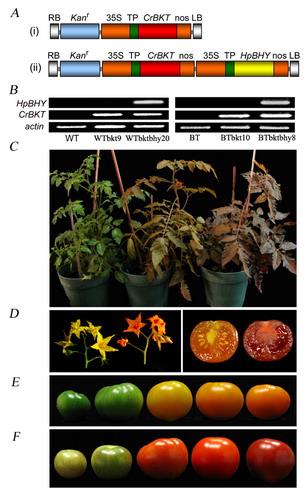
Phenotypes of T1 generation tomatoes over expressing the CrBKT or HpBHY-CrBKT genes.