-
[ June 17, 2013]
Professor Ruqiang Zou’s team made progress in the research of nanoporous energy materials
-
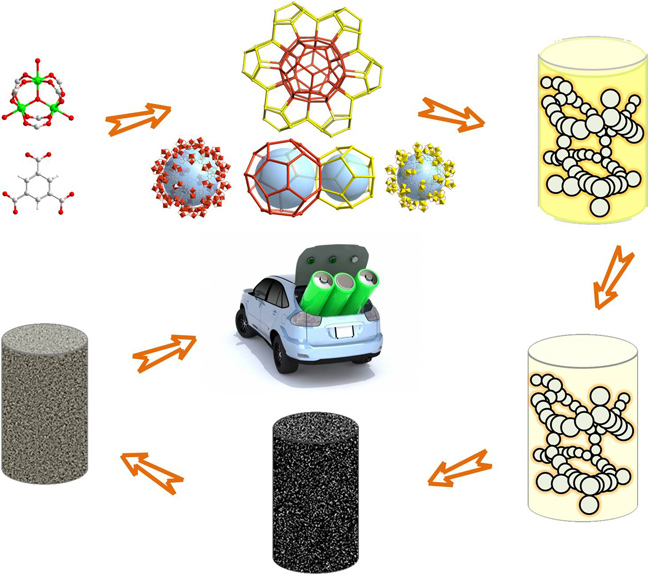
Recently, the research team lead by Professor Ruqiang Zou from the College of Engineering has made an important progress in the study of nanoporous energy materials. Related paper “Facile preparation of hierarchically porous carbons from metal-organic gels and their application in energy storage” has been published in Scientific Reports of the Nature Publishing Group. (http://www.nature.com/srep/2013/130603/srep01935/full/srep01935.html).
Nanoporous materials have the high surface area, tunable pore size and high stability. Due to these properties, they have drawn tremendous attentions in the fields of energy storage and conversion, such as hydrogen storage, batteries, and catalysts. However, it’s still challenging in scalable synthesis of nanoporous materials with high surface area. Designing and preparing three-dimensional porous bulk bearing the target texture has been rarely reported.
Professor Zou’s team put forward a new strategy. By using a novel metal-organic gel as a self-template, they rationally designed the products’ structures at microscale and greatly simplified the synthetic process. The resultant materials have hierarchical porous architectures with ultrahigh surface areas and quite large pore volumes. They exhibit considerable hydrogen uptakes, which are comparable to the benchmark porous materials that have the best known performance.
Meanwhile, their research showed that by adding simple treatment to the gel template, a three-dimensional carbon monolith could be acquired. The unique structure of this type of product provides distinctive conditions for the excellent electrochemical performance as cathode material for lithium-sulfur battery.
“The inter-connected pores accelerate the mass transport and the carbon matrix offers a good conducting network and sulfur confinement basement. This strategy presents a new idea for designing cathode structure in lithium-sulfur battery,” commented by Zou, corresponding author of the paper.
First author of the paper Wei Xia is a Ph.D. student in the Department of Materials Science and Engineering, College of Engineering and Professor Dingguo Xia from the same department is the co-investigator.
The work is supported by the National Basic Research Program of China, National Natural Science Foundation of China, New Star Program of Beijing Committee of Science and Technology, the Ministry of education program for New Century Excellent Talents of China and Singapore-Peking University SPURc program.