
-
[ December 27, 2013]
Fluorescence labelling toward a new dimensional encoding
-
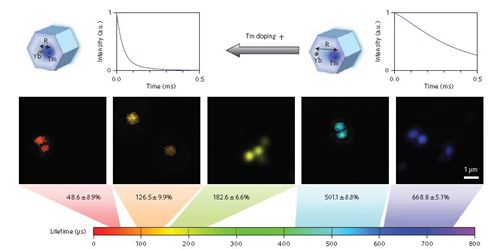
A team of researchers has invented a new generation of nanocrystal named t-Dots, from which the emission time of the fluorescent light can be engineered. Detection based on the lifetime of the fluorescence can be exploited to code individual upconversion nanocrystals, offering a new optical encoding in the time dimension. The breakthrough has been the work of an international collaboration of Dayong Jin research group from Macquarie University in Australia, J Paul Robinson research group from Purdue University in USA, and Peng Xi research group from College of Engineering, Peking University.
Traditionally, fluorescent color (wavelength) coding is used to distinct different organelles stained, and then studying the molecular mechanisms of the associated diseases. However, conventional fluorescent color coding is limited by spectral overlap and background interference, restricting the number of distinguishable identities. While the quantum dot narrowing fluorescence spectrum alleviates this problem partially, the coding amount can’t obtain essential improvement because of the physical mechanism of color coding. Coding from other temporal and spacial dimensions is the key to solve this problem.
The new nanoparticle with continuously tunable luminescent lifetimes ranging from tens to hundreds of microsecond achieves high-precision encoder, quickly and accurately identified by time-resolved confocal laser scanning microscopy and flow cytometry. Formerly, researchers focused more on color-resolved imaging and nanosecond level fluorescence lifetime imaging, lowering the number of encoding. Based on extra dimension of time encoding offered by upconversion nanocrystal, τ-dot opens up new application in multi-channel bioimaging, high-throughput cytometry quantification, high-density data storage, as well as security codes to combat counterfeiting. The paper entitled “Tunable lifetime multiplexing using luminescent nanocrystal“ in form of letters was published online in Nature Photonics December 16, 2013 (DOI:10.1038/NPHOTON.2013.322).
http://www.nature.com/nphoton/journal/vaop/ncurrent/full/nphoton.2013.322.htmlDr. Peng Xi did his postdoctoral training under the supervision of Professor J Paul Robinson at Purdue Cytometry Laboratories in 2004-2005. His group’s (http://bme.pku.edu.cn/~xipeng) research areas include super-resolution microscopy, confocal laser scanning microscopy, multiphoton microscopy, and optical coherence tomography. The Advanced Cytometry Labs in Macquarie University, Australia is led by Dr. Dayong Jin (http://physics.mq.edu.au/directory/person.htm?id=jin). The lab has been committed to achieve new technology of background-free, high speed and high quantum yield flow cytometry detection, slide cell detection, rare event high-speed detection from massive sample by optical time-resolved detecting in combination with rare-earth molecular probes.
This is the second time a collaborative success between Dr. Jin’s group in Macquarie University and Xi group in Peking University, after their achievement of ultra-sensitive single upconversion nanocrystals probe published in Nature Nanotechnology two months ago. Up to now, the two groups have cooperatively published 9 articles in leading international journals, dating back to 2010.
Media reports:
1. Timing is everything in new nanotechnology for medicine, security and research, http://www.purdue.edu/newsroom/releases/2013/Q4/timing-is-everything-in-new-nanotechnology-for-medicine,-security-and-research.html
2. New Generation of Nanocrystals' Could Help Screen For Cancer, And Identify Counterfeit Drugs http://www.hngn.com/articles/19714/20131216/new-biotechnology-could-help-screen-for-cancer-and-identify-counterfeit-drugs-using-nanocrystals.htm
3. New Nanocrystals Offer Rapid Diagnostics And Anti Drug Counterfeiting: http://www.hospitalhealth.com.au/news/new-nanocrystals-offer-rapid-diagnostics-anti-drug-counterfeiting/
4. http://www.mq.edu.au/newsroom/2013/12/16/new-biotechnology-offers-rapid-diagnostics-and-anti-drug-counterfeiting/