
-
[ March 15, 2015]
Dr. Xing Fang from Auburn University gives a seminar in College of Engineering
-
On March 10, invited by the Center of Water Research of Peking University, Dr. Xing Fang who worked in the Department of Civil Engineering of the Samuel Ginn College of Engineering at Auburn University, gave a seminar entitled “Projections of Climate Impacts on Water Quality Characteristics and Fish Habitats in Lakes of the Contiguous USA” at Peking University. Prof. Yi Zheng hosted this event.
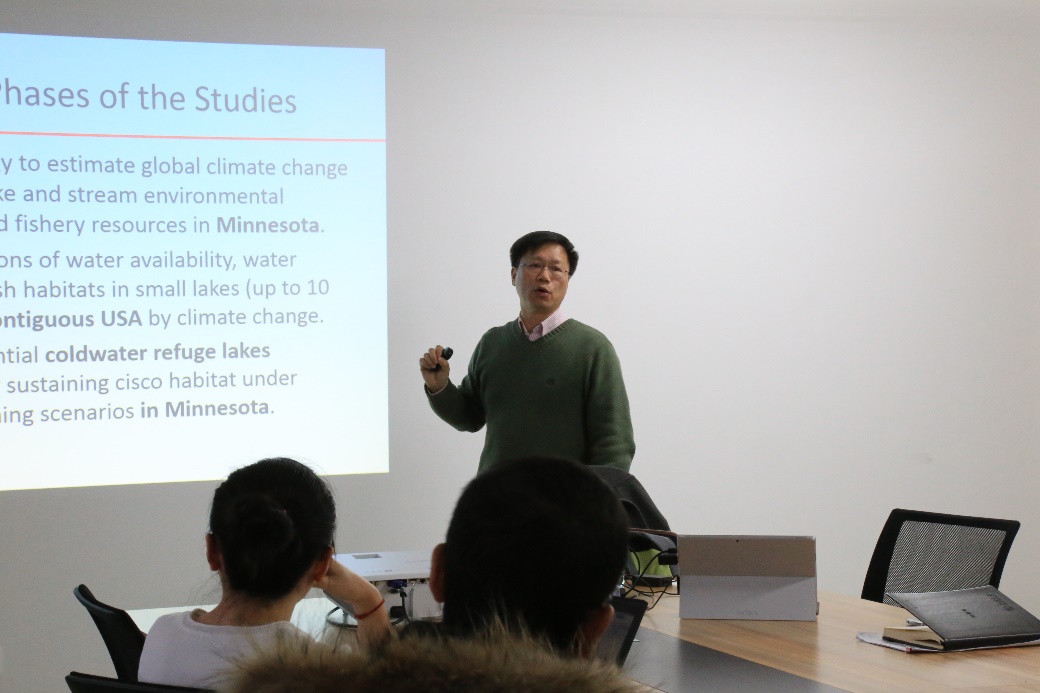
In his talk, Dr. xing Fang introduced that daily water temperature (T) and dissolved oxygen (DO) profiles were simulated for 44 representative and 30 virtual lake types (up to 50 km2 surface area) in the contiguous United States under past climate (observed from 1961 to 2008) and for projected future climate conditions. A verified, process-oriented, dynamic, and one-dimensional year-round lake water quality model (MINLAKE) was applied to simulate water temperature and DO profiles continuously in daily time steps over a 19 to 48-year simulation period. The future climate scenario is projected to increase lake surface temperatures by up to 5.2 oC when the climate scenario projects an increase of mean annual air temperature up to 6.7 oC. The future climate scenario is projected to increase the duration of seasonal summer stratification by up to 67 days, to shorten ice cover by up to 90 days, and to reduce the maximum ice thickness by up to 0.44 m. Under a future climate scenario, Lake Anoxia during the period of ice cover is projected to shorten so that fish winterkill can be avoided, but the periods of hypolimnetic summer anoxia are projected to lengthen. Three oxythermal fish habitat modeling options were developed: (1) constant lethal T and DO limits, (2) lethal-niche-boundary curve, and (3) an oxythermal habitat variable, TDO3 (T at DO = 3 mg/L). Summerkill under future climate scenario is projected to have a significant negative influence on northern lakes and on cool-water fish in southern lakes where suitable habitat existed under historical conditions. The largest negative impact of climate warming on cold-water fish habitat occurs in medium-depth lakes (maximum depth of 13 m). Warm-water fish habitat is projected to be extended in all lakes investigated. Under the future climate scenario, good-growth periods are projected to increase by 37 day for cool-water fishes. Revised MINLAKE model was used to identify refuge lakes of a cold-water fish species cisco (Coregonus artedi) in Minnesota.
Dr. Fang is a full professor in the Department of Civil Engineering of the Samuel Ginn College of Engineering and has worked at Auburn University since August, 2007. His research interests include environmental hydrodynamics, ecological modeling, and water resources engineering (hydraulics and hydrology).Dr. Fang was elected to be a Fellow of the American Society of Civil Engineers (F.ASCE) on February 11, 2014. He also became a Fellow of the ASCE Environmental & Water Resources Institute (F.EWRI) on May 16, 2014.