
-
[ May 11, 2015]
Dr. Xiaolan Xie from Ecole Nationale Supérieure des Mines de Saint Etienne France gives a seminar in College of Engineering
-
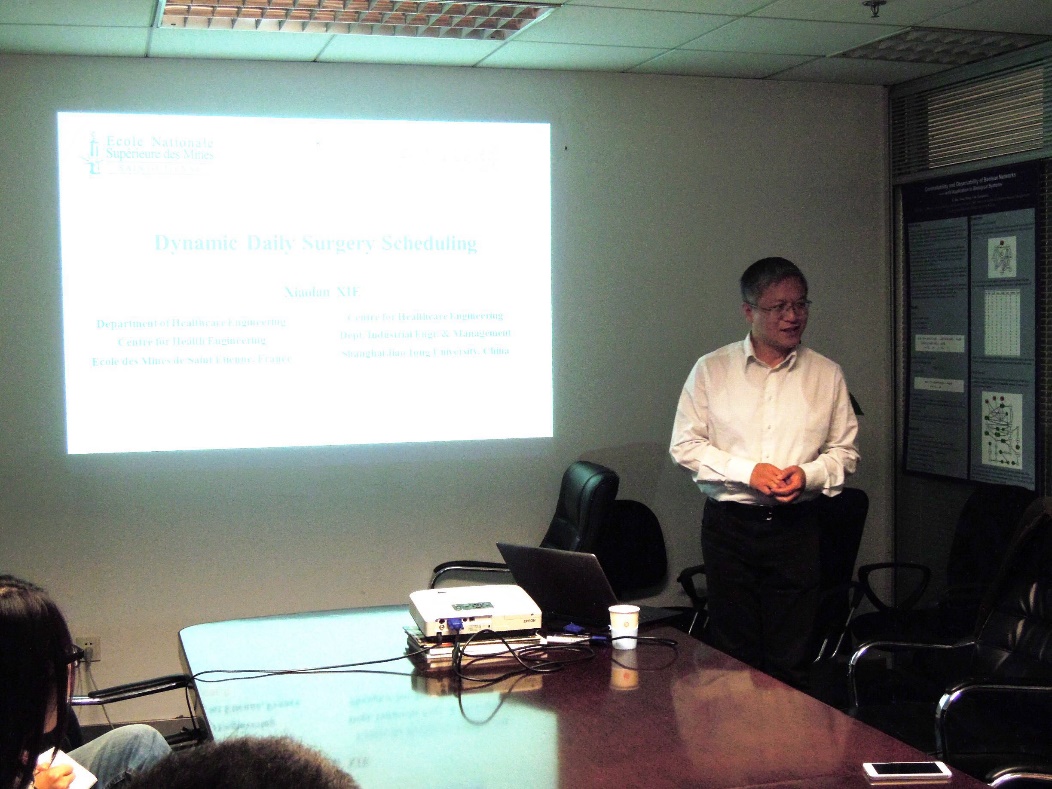
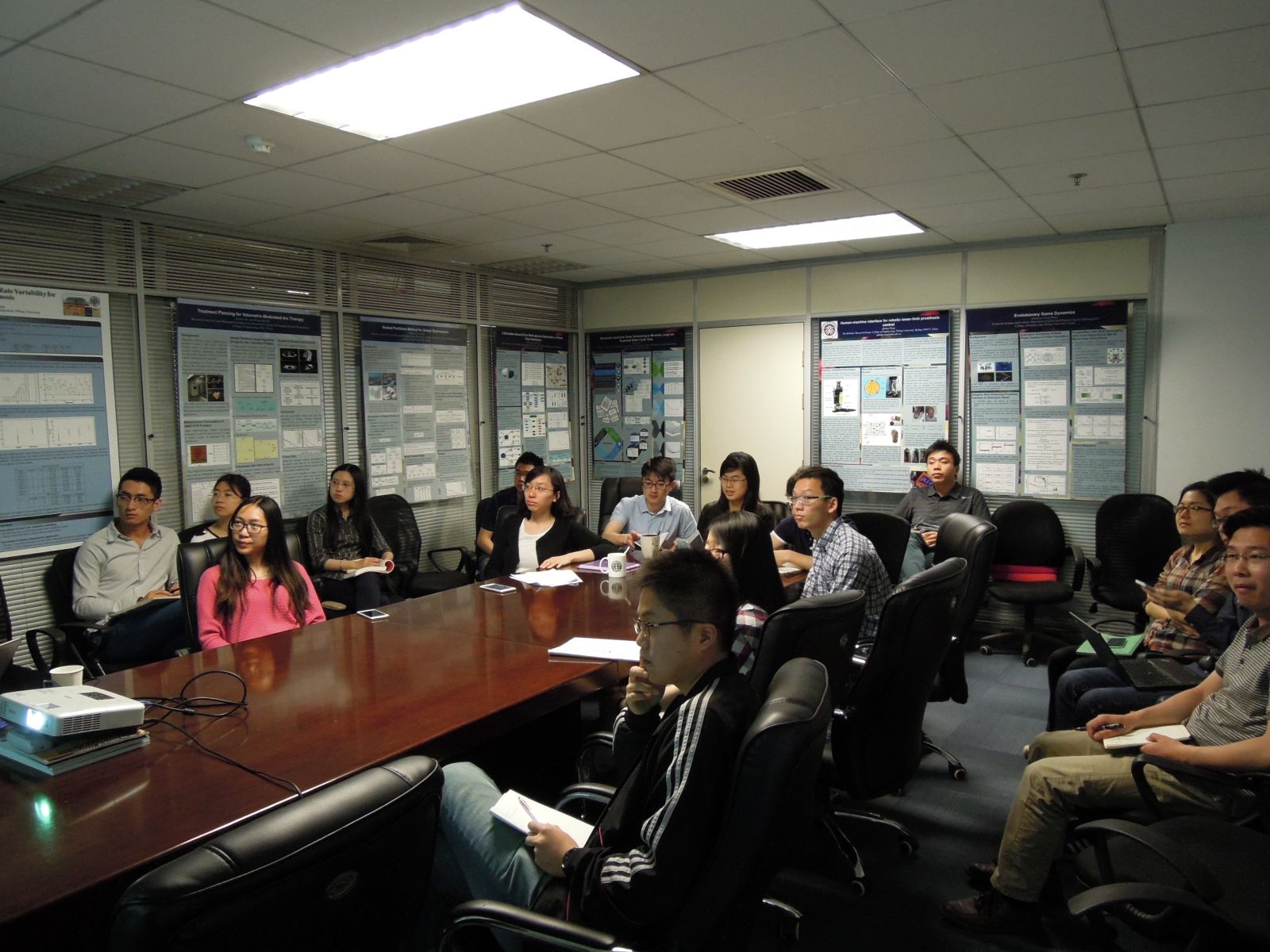
On May 08, Dr. Xiaolan Xie who worked in Ecole Nationale Supérieure des Mines de Saint Etienne France gave a seminar entitled "Dynamic surgery scheduling of multiple operating rooms” at room 512 in Founder Group, Peking University. Prof.Jie Song hosted this event.
-
In this talk, Dr. Xiaolan xie focused on daily surgery scheduling in a multi-OR setting where OR stands for Operating Rooms with random surgery durations.Dr.Xie first addressed the dynamic assignment of a given set of surgeries with planned surgeon arrival times also called appointment times. Surgeries are assigned dynamically to ORs at surgery completion events. The goal was to minimize the total expected cost incurred by surgeon waiting, OR idling, and OR overtime. He first formulated the problem as a multi-stage stochastic programming model. An efficient algorithm was then proposed by combining a two-stage stochastic programming approximation and some look-ahead strategies. A perfect information-based lower bound of the optimal expected cost was given to evaluate the optimality gap of the dynamic assignment strategy. Numerical results showed that the dynamic scheduling and optimization with the proposed approach significantly improved the performance of static scheduling and First Come First Serve (FCFS) strategy.
Dr. Xiaolan Xie then addressed the optimization of surgeon appointment times for a sequence of surgeries. Surgeries was assigned to ORs dynamically on a FCFS basis. It materially differed from past literature in the sense that dynamic assignments are proactively anticipated in the determination of appointment times. A discrete-event framework was proposed to model the execution of the surgery schedule and to evaluate the sample path gradient of a total cost incurred by surgeon waiting, OR idling and OR overtime. The sample path cost function was shown to be unimodal, Lipchitz continuous and differentiable w.p.1 and the expected cost function continuously differentiable. A stochastic approximation algorithm based on unbiased gradient estimators was proposed and extensive numerical experiments suggest that it converged to a global optimum. A series of numerical experiments were performed to show the significant benefits of Multi-OR and properties of the optimal solution with respect to various system parameters such as cost structure and numbers of surgeries and ORs.
 Xiaolan XIE received his Ph.D degree from the University of Nancy I, Nancy, France, in 1989, and the Habilitation à Diriger des Recherches degree from the University of Metz, France, in 1995.Currently, he is a distinguished professor of industrial engineering, the head of the department of Healthcare Engineering of the Center for Health Engineering and the head of IEOR team of CNRS UMR 6158 LIMOS, Ecole Nationale Supérieure des Mines (ENSMSE), Saint Etienne, France. He is also a chair professor and director of the Center for healthcare engineering at the Shanghai Jiao Tong University, China. Before Joining ENSMSE, he was a Research Director at the Institut National de Recherche en Informatique et en Automatique (INRIA) from 2002 to 2005, a Full Professor at Ecole Nationale d’Ingénieurs de Metz from 1999 to 2002, and a Senior Research Scientist at INRIA from 1990 to 1999. His research interests include design, planning and scheduling, supply chain optimization, and performance evaluation, of healthcare and manufacturing systems. He is author/coauthor of over 250 publications including over 90 journal articles and five books. He has rich industrial application experiences with European industries. He is PI for various national and international projects including ANR-TECSAN HOST on management of winter epidemics, NSF China key project on planning and optimization of health care resources, French Labex IMOBS3 project on home health cares, FP6-IST6 IWARD on swarm robots for health services, FP6-NoE I*PROMS on intelligent machines and production systems, the FP5-GROWTH-ONE project for the strategic design of supply chain networks, the FP5- GRWOTH thematic network TNEE on extended enterprises.Dr. Xie is a fellow of IEEE. He has been an associate editor for IEEE Transactions on Automation Science & Engineering, IEEE Transaction on Automatic Control, IEEE Transactions on Robotics & Automation and International Journal of Production Research. He has a Guest Editor of various special issues on healthcare engineering and manufacturing systems. He is general chair of ORAHS’2007 and IPC chair of the IEEE Workshop on Health Care Management WHCM’2010.
-