
-
[ April 21, 2015]
Jianjun Tao’s Group makes progress on the study of the subcritical transition in plane-Poiseuille flow
-
In 1928, Davies and White [1] systematically measured the friction factor of plane-Poiseuille flow (PPF) at different Reynolds numbers (Re), but in the past eight decades people’s understanding of its transition mechanism is still rudimental. The main reasons lie in two aspects. First, in order to avoid the side boundary effect and to study the streamwise evolution, the spanwise and streamwise length scales of the flow domain should be very large, and these requirements have challenged the applicable experimental techniques and computation ability. Second, early experimental observations revealed that spots triggered by artificial disturbance (e.g. suction and blowing) could survive when Re was larger than 1000. Consequently, most previous studies focused on spots at relative high Re (Re>1000). However, it should be reminded that the artificial disturbances are not the most effective form of perturbation.
Tao’s Group has cooperated with the Linné FLOW Centre at KTH and carried out systematical direct numerical simulations (DNS) of PPF by using TianHe -1(A) at NSCC-TJ (National Supercomputing Center, Tianjin) in the past three years, and obtained the following results.
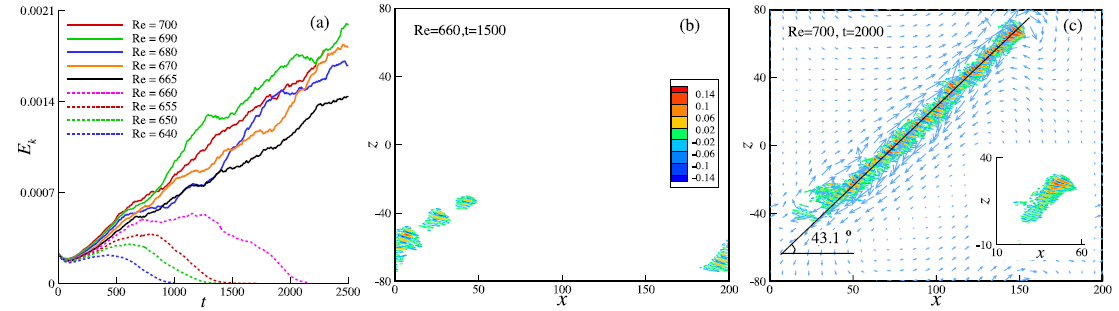
Fig.1 (a) Kinetic energy of disturbance, (b) turbulent band breaking, (c) oblique extension of turbulent band. The inset of (c) shows the band ‘seed’ used as initial disturbance. The iso-contours of the transverse velocity and the vector field of mean flow in the plane parallel to the walls are shown as well.
I. The typical structure of the subcritical transition of PPF is not spot but isolated turbulent band (ITB), which is composed of small-scale perturbations surrounded by large-scale circulation flow. Since spots either decay or develop to turbulent bands, they have much shorter lifetime than ITB. The statistical properties of ITB, e.g. streamwise length, spanwise length, advection velocity and oblique angle, are independent of initial disturbances. This coherent structure is selected by the flow field itself, and hence is the most effective form of perturbation.
II. When Re<660, it is found that short turbulent bands will decay eventually. When Re≥665, ITB can extend continuously if it doesn’t interact with other bands or spots (Fig.1c). This result is consistent with Davies and White’s experiment, where the friction factor started to deviate slightly from the laminar value as Re>667.
III. The interaction between bands may lead to band breaking and decay when 1000>Re≥665. With the increase of Re, band split occurs and produces band ‘seeds’ (Fig.2). The turbulence spreading caused by oblique extension and band split is found to overcome the decay process when Re>1000. As a result, the temporally sustained turbulence is obtained eventually.
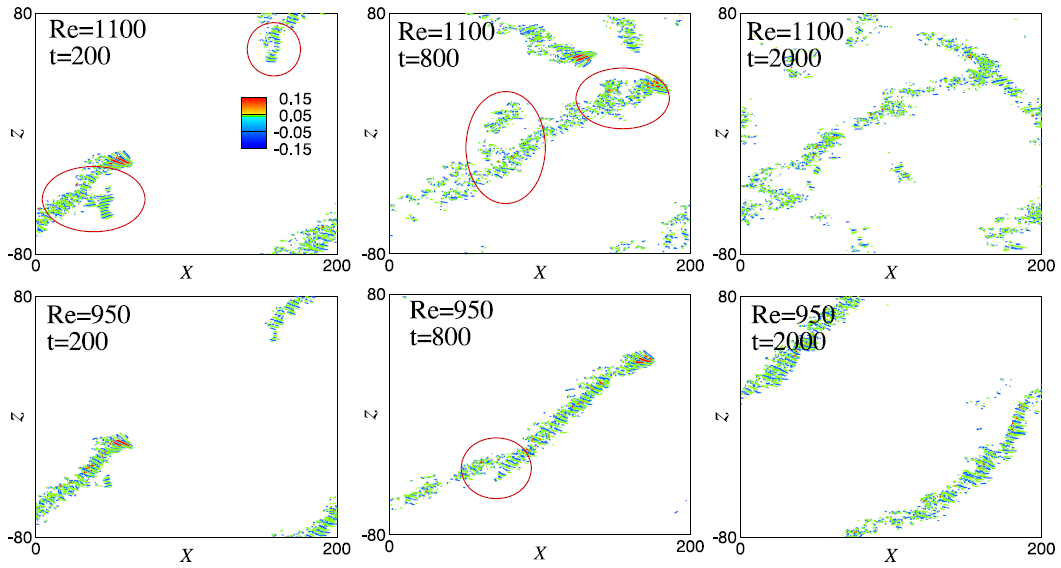
Fig.2 Temporal evolutions of the same ITB at different Reynolds numbers. Ek as a function of time is shown on the left, and the iso-contours of the transverse velocity in the midplane at different Res and time are shown on the right. The red circles indicate the regions of band split.
These results reveal the scenarios of the subcritical transition at moderate Reynolds numbers and are published in Physics of Fluids [2]. Another paper discussion the late stage of the transition is to be submitted.
[1] S. J. Davies & C. M. White, An experimental study of the flow of water in pipes of rectangular section, Proc. R. Soc. A 119, 92-107 (1928).
[2] X. Xiong, J. Tao, S.Y. Chen, L. Brandt, Turbulent bands in plane-Poiseuille flow at moderate Reynolds numbers, Phys. Fluids 27, 041702 (2015) .