
-
[ March 30, 2015]
Professor Ruqiang Zou’s team has achieved breakthroughs in nanoporous energy materials
-
Recently, a research team lead by Professor Ruqiang Zou from the College of Engineering has made important progresses in the study of nanoporous energy materials.
The oxygen reduction reaction (ORR) has been one of the most fundamentally and technologically important electrochemical reactions for fuel cells and lithium air batteries. The sluggish ORR process requires the assistance of electrocatalysts for the activation. Pt-based nanomaterials have been the dominant and best electrocatalysts for promoting the ORR. However, the scarcity, high cost and low stability of Pt hinder its practical application. Rational design of non-noble metal catalysts with an electrocatalytic activity comparable or even superior to Pt is extremely important for future fuel cell-based renewable energy devices.
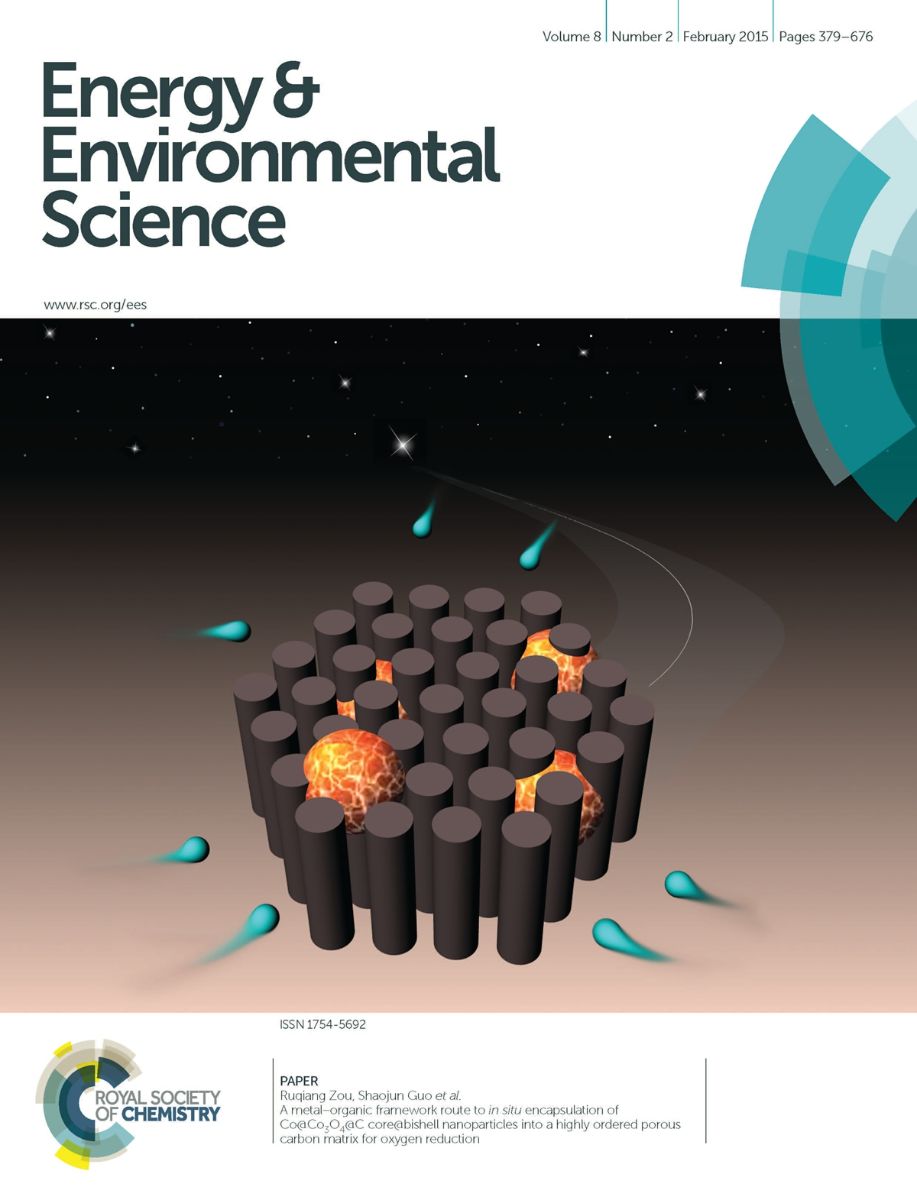
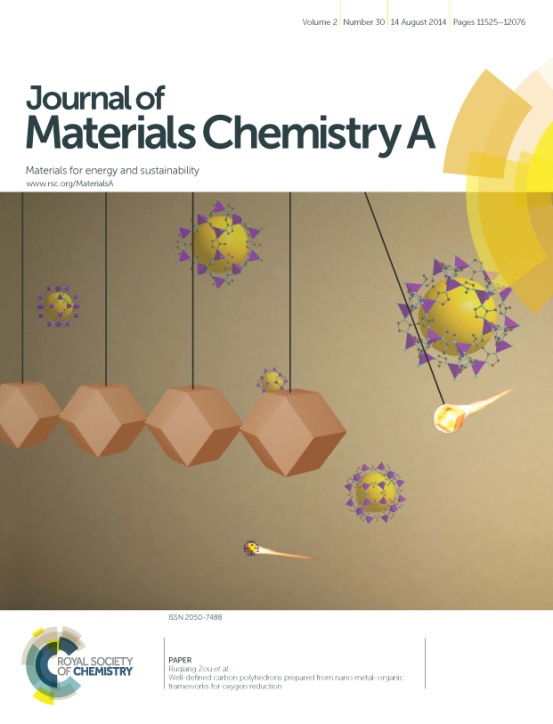
Zou’s group and co-workers have developed a new method of constructing cheap ORR electrocatalyst from a nano-size metal-organic framework, a highly porous crystalline material that can be obtained in minutes via mild condition. Through simple treatment, they obtained cobalt and nitrogen co-doped carbon nanoparticles that possess high surface area and rich porosity. The product has shown surprisingly high activity and stability toward ORR in both acidic and alkaline solutions. Furthermore, Zou’s group has systematically studied the influence of the catalyst microstructure towards the ORR performance. They further improve the catalyst performance through molecular design and morphology evolution. The research articles titled “A metal–organic framework route to in situ encapsulation of Co@Co3O4@C core@bishell nanoparticles into a highly ordered porous carbon matrix for oxygen reduction” and “Well-defined carbon polyhedrons prepared from nano metal–organic frameworks for oxygen reduction” have been published in Energy & Environmental Science (http://pubs.rsc.org/en/Content/ArticleLanding/2015/EE/C4EE02281E) and Journal of Materials Chemistry A (http://pubs.rsc.org/en/content/articlelanding/2014/ta/c4ta01656d), respectively. Both articles are selected as front cover pictures. The first author of the two papers is Wei Xia, a 4th year Ph.D. candidate.
In addition, Zou’s group has prepared novel porous carbon coated CoS2 nanoparticles from metal-organic framework, which can be applied as cathode for high performance Li-ion battery. The ultra-small CoS2 (15 nm) nanoparticles in N-rich carbon exhibit promising lithium storage properties with negligible loss of capacity at high charge/discharge rate. At a current density of 100 mA g-1, a capacity of 560 mAh g-1 is maintained after 50 cycles. Even at a current density as high as 2500 mA g-1, a reversible capacity of 410 mA h g-1 is obtained. It has shown great potential for Li-ion battery application. The related work titled “Facile Synthesis of Ultrasmall CoS2 Nanoparticles within Thin N-Doped Porous Carbon Shell for High Performance Lithium-Ion Batteries” has been published in Small (http://onlinelibrary.wiley.com/doi/10.1002/smll.201403579/full). This work was selected as frontispiece of Small journal and highlighted by MaterialsViewsChina (http://www.materialsviewschina.com/2015/03/new-type-of-anode-material-for-lithium-ion-batteries-carbon-nitrogen-doped-porous-coated-cobalt-sulfide-nano-particles-composite-structure-building/). The first author of this work is Qingfei Wang, a 3rd year Ph.D. candidate.
This study is supported by the National Natural Science Foundation of China, New Star Program of Beijing Committee of Science and Technology, the Ministry of education program for New Century Excellent Talents of China and The Excellent Young Scientist Foundation of NSFC.