
-
[ November 21, 2011]
Professor Mary Anderson of the U.S. Academy of Engineering gives lecture on water resources
-
On November 17, upon invitation by Professor Chunmiao Zheng, director of the Peking University Water Center, Professor Mary Anderson of the University of Wisconsin gave a lecture entitled “New Directions and Re-Invention for Research in Groundwater Hydrology” at the Peking University Library.
The lecture served as the first lecture of the Peking University Water Center “Frontiers of Hydrologic Sciences” Distinguished Lecture Series. Over 100 teachers and students of the Water Center, China University of Geology, Institute of Hydrogeology and Environmental Geology of the Chinese Academy of Geological Sciences attended the lecture.
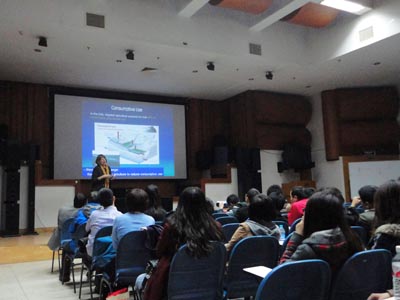
Anderson mentioned the three grand challenges in groundwater hydrology for the 21st century as listed by the U.S. Academy of Engineering in 2008: clean water, agricultural nitrogen cycle and carbon storage in the context of climate change. She pointed out that these were not entirely new issues; hydrologists had studied them for a long time, but the new ideas and challenges emerging in the re-invention of these issues were worth looking at.
For instance, in the 1950s, the concept of ”safe yield” was brought up, which means the utmost annual amount of groundwater extraction that would not have hazardous effect on the environment. Today, the concept has extended to groundwater sustainability, which means the amount of extraction that satisfies the current demand without sacrificing the needs of future generations. The concept of ethics is also raised today. Groundwater, spring water, plants and animals are individual members of the hydrological and ecological systems just as human beings, so they enjoy the same rights. This makes it necessary for humans to strengthen integrated watershed management and control of groundwater pollution.
In response to the growing demand on water resources by the increasing population, we should not only reduce the demand by cutting on agricultural irrigation and other consumptions, but also increase the supply by means of seawater desalination and reuse of water resources, according to Anderson.
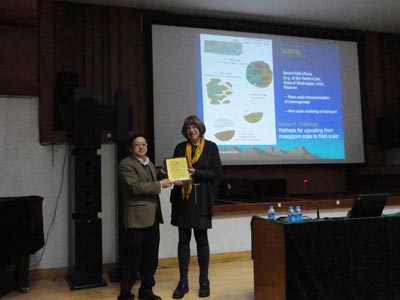
After the talk, Anderson was presented the Certificate of Guest Professor from Professor Dongxiao Zhang, executive vice dean of the College of Engineering.
***
About Mary P. Anderson
Mary P. Anderson received her Ph.D. (1973-Hydrology) from Stanford University. She joined the Department of Geoscience at the University of Wisconsin-Madison in 1975, where she is the C.S. Slichter Professor (Emeritus). She has co-authored two popular textbooks on groundwater modeling and over 100 technical publications. She is a member of the U.S. National Academy of Engineering and a fellow of both the American Geophysical Union (AGU) and the Geological Society of America (GSA). She has received numerous awards including M.K. Hubbert Award, O.E. Meinzer Award, C.V. Theis Award, AGU Langbein Lecturership, and three distinguished service awards. She recently completed a nine-year term as editor-in-chief of the international journal “Ground Water” and was editor of a book (2008) on benchmark papers in groundwater hydrology.