
-
[ November 30, 2011]
Suppressing cancer metastasis
-
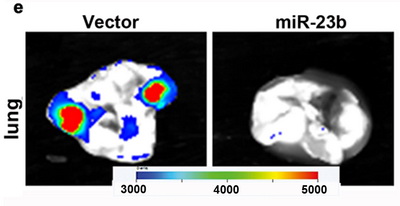
Images of lungs isolated from mice that received a tail vein injection of miR-23b-transduced or mock-infected green fluorescent protein-labelled HCT 116 cells.
A research group from the College of Engineering just reported its study of genome-wide functional screening of miRNA in cancer metastasis. They found that one of miRNAs, miR-23b, potently mediates the multiple steps of metastasis, including tumor growth, invasion and even angiogenesis in vivo. These findings provide new insight into the physiologic and potentially therapeutic importance of miRNAs as a new class of functional modulators.
Metastasis is the overwhelming cause of mortality in patients with solid tumors. Over 90 percent of patients die from cancer due to metastasis. It is a complex and dynamic process, starting with local invasion, followed by intravasation into the systemic circulation, survival in the circulation, extravasation and establishment at distant tissues, and ultimately vascularization of the resulting tumors. Therefore, a more complete understanding of the molecular mechanism that regulates this process requires a detailed characterization of cell motility, invasion, growth and even angiogenesis.
“Recently, miRNAs, a group of endogenous small non-coding RNAs, have attracted great attention from the whole biological and medical fields because of their unique features, including multi-target regulation, tissue specificity, and evolutionary conservation”, said Jianzhong Xi, a professor in the College of Engineering Department of Biomedical Engineering, who led the work, “However, an outstanding central question is how many miRNAs functionally participate in cancerogenesis, particularly in cancer metastasis.”
To address this question, the research group decided to quantitatively and systematically characterize the capacity of individual miRNAs to regulate cell migration, invasion, and apoptosis. They developed a novel self-assembled cell microarray (SAMcell), which is suitable for the high-throughput screening of the genes functionally regulating cell migration. Through the screening of migration regulatory miRNAs, followed by the implementation of invasion or apoptosis assay, they showed that over 20 percent of miRNAs have migratory regulation activity in diverse cells. They also found that one of miRNA, miR-23b, mediates the various steps in the metastatic process, including tumor growth, invasion and even angiogenesis by repressing a cohort of prometastatic targets. These findings provide new insight into the physiologic and potentially therapeutic importance of miRNAs as a new class of functional modulators.
***
This work was published on the journal of Nature Communications on Nov. 22nd, 2011. http://www.nature.com/ncomms/journal/v2/n11/full/ncomms1555.html