
-
[ November 04, 2011]
Professor Qiushi Ren’s research on reading pixelized paragraphs of Chinese characters using simulated prosthetic vision
-
Professor Qiushi Ren in the Department of Biomedical Engineering has teamed up with scientists from Shanghai Jiaotong University to study Chinese character reading performance using simulated prosthetic vision.
They have examined the various parameters that affect reading performance of pixelized Chinese paragraphs.
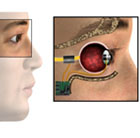
Visual prostheses offer a possibility of restoring useful reading ability to the blind. To achieve optimal Chinese reading performance, Ren and his team examined the reading accuracy and efficiency of pixelized Chinese paragraphs. They tested 40 native Chinese speakers with normal or corrected visual acuity (20/20) in four experiments, measuring ready accuracy and efficiency while altering character resolution, character size, pixel dropout percentage, number of gray levels, and luminance.
The results showed that a 5 degrees x 5 degrees character appeared to be the optimal size necessary for accurate pixelized reading. They also found out that compared with pixelized character recognition, pixelized Chinese paragraph reading achieved higher accuracy; thus, optimal Chinese reading performance may require prostheses with more electrodes (1000) than are required to read paragraphs in the Latin alphabet (500).
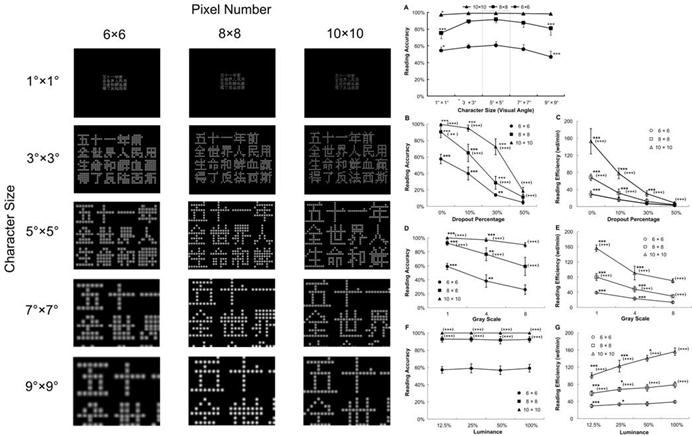
Their research article has been published in Investigative Ophthalmology & Visual Science. (Ying Zhao, Yanyu Lu, Ji Zhao, Kaihu Wang, Qiushi Ren, Kaijie Wu, Xinyu Chai, “Reading Pixelized Paragraphs of Chinese Characters using Simulated Prosthetic Vision”, Investigative Ophthalmology & Visual Science (IOVS), 2011, 52(8):5987-5994.)