
-
[ May 04, 2012]
Beijing government recognizes COE application-driven research projects
-
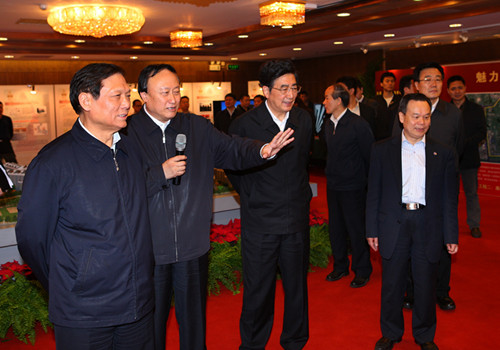 Three College of Engineering research projects received recognition from Qi Liu, Party Secretary of Beijing City, during a recent visit to Peking University with the purpose of deepening the city-university relations and cooperation. He expressed his intention to support the industrialization process of the projects.
The delegation of Beijing government top officials, led by Liu and Mayor Jinglong Guo, viewed the "Research Achievements Exhibition" in Peking University’s Yingjie Overseas Exchange Center, which features many of the university’s application-driven research projects. Three COE projects are featured: “Technology of Intelligent Assistive Limbs Based on Dynamic Walking Mechanism,” “Thermostat Film” and “Rapid Non-Invasive Tumor Diagnostic Equipment.”
Technology of Intelligent Assistive Limbs
The project on intelligent assistive limbs based on dynamic walking mechanism has the potential to improve the quality of life for people with mobility disabilities.Unlike traditional assistive limbs, the product has interacts with human bodies and is controlled by its user’s physiological signals. Yijun Liu, a Beijing resident who had his left leg amputated, demonstrated his ability to walk with the aid of an intelligent assistive limb. He called the device “easy to use.”
Intelligent assistive limb technology caught the attention of the government in 2010; last year, Beijing Disabled Persons Associated provided 20 million RMB in research funds and 15 million RMB in industrialization funds. The product is expected to enter the market soon.
Thermostat Film
Professor Huai Yang’s team in the Department of Materials Science and Engineering is carrying out research on thermostat film.The film automatically senses changes in ambient temperature and adjusts the transmittance of infrared red automatically; no energy is required. Thermostat film does not insulate light or heat in low temperature, and only insulates heat in high temperatures. If fitted on doors and windows, it could effectively regulate room temperature.
At present, the product has been completed in trial, and can be widely applied to glass walls, open lounges, ATM rooms and surveillance areas.
Rapid Non-Invasive Tumor Diagnostic Equipment
The project is carried out in the Department of Biomedical Engineering, concerning an innovative device based on new technology in infrared spectroscopic diagnosis of tumors. The device could discriminate between tumor and normal tissues with a non-invasive, harmless and painless approach. It has great market potential in hospitals for quick diagnosis and identification of tumor areas for surgical removal."The three projects impressed me with high innovative levels and practical values," Liu said. “I think the projects meet the pressing demands of the society, so we should support their industrialization progress to increase their impacts.”