
-
[ May 29, 2013]
Prof. Evelyn N. Wang talks about heat transfer enhancement opportunity
-
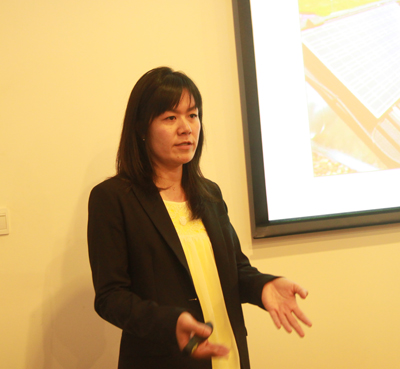 Invited by Professor Xinrong Zhang, Department of Energy and Resources Engineering of the College of Engineering (COE), Prof. Evelyn N. Wang, an Associate Professor in the Mechanical Engineering Department at MIT, gave a lecture on “Nanoengineered Surfaces for Enhanced Phase-Change Heat Transfer” to COE faculty and students on May 24th.
"Nanoengineered surfaces promise enhanced phase-change heat transfer, which has important applications in thermal management, building environment control, water harvesting, desalination, and industrial power generation," said Prof. Wang.
In order to find solutions for high heat flux cooling, Wang has investigated nanoengineered surfaces and examined them under pool boiling and condensation conditions. In the talk, She discussed fundamental studies of droplet and bubble behavior on nanoengineered surfaces, and the effect of manipulating these fluid-structure interactions on boiling and condensation heat transfer.
Wang pointed out that phase-change heat transfer is an efficient tool to deal with gradually increased critical heat flux of electric devices. Taking pool boiling and condensation as two examples, she explained how nanoengineered surface acts on phase-change heat transfer enhancement. In pool boiling, she explained the role of surface roughness on critical heat flux enhancement with experiments and modeling. Accordingly, a critical heat flux of ≈250 W/cm2 with hierarchical structures with a surface roughness of ≈13 has been demonstrated. In condensation, she elucidated the importance of structure geometry on droplet morphology, growth and departure dynamics. In addition, she promised ≈30% higher heat transfer coefficients compared to that on state-of-the-art dropwise condensing surfaces using functionalized copper oxide nanostructures.
"These studies provide key insights into the complex physical processes underlying fluid-structure interactions for heat transfer enhancement and also provide a path to achieving increased efficiency in next generation thermal systems," she concluded.
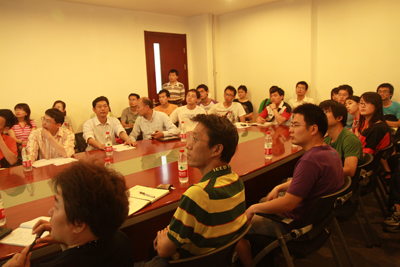
In the Q & A section, questions are raised by the attended teachers and students. Wang replied them one by one and made detailed explanations on some of them.
“So far, cooling under high heat flux is a Gordian knot in the specific field, and the study is a welcome news to science and industry,” Zhang commented.