-
[ Janurary 11, 2014]
Pingchou Han’s group presents research in circulating tumor cells
-
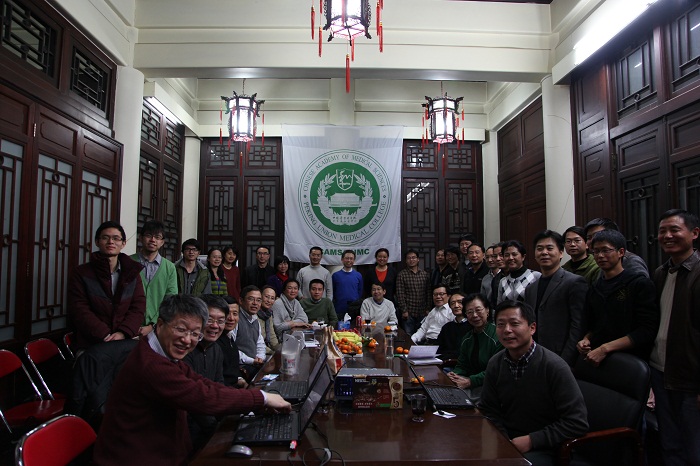
Professor Pingchou Han from the Department of Materials Science and Engineering (MSE) at the College of Engineering was invited to take part in the Academic Salon Lecture organized by the Chinese Academy of Medical Sciences and Peking Union Medical College recently. The presentation “CTC-assay: segregation and recovery of circulating tumor cells from the peripheral blood of cancer patients” given by Prof. Han’s senior PhD student Zhewen Tang was recognized by the attendees.
Nearly 40 professors and students from the Institute of Basic Medical Sciences, Institute of Medicine, Institute of Medicinal Plant Development (IMPLAD), Peking Union Medical College Hospital, Fuwai Hospital and Cancer Hospital attended the lecture.In the presentation, Zhewen Tang presented Professor Han’s team’s effort in the capture and recovery of circulating tumor cells (CTCs) sourced from cancer patient’s blood. Evidence suggests that CTCs are responsible for the hematogeneous spread of cancer from the primary tumor to distant sites in the human body, and this metastasis is responsible for over 90% of cancer deaths. The enumeration of rare circulating tumor cells (CTCs) in the peripheral blood is a strong prognostic indicator of the severity of cancer and the technology is now starting to be introduced into commercial systems as the technique for liquid biopsy. Therefore, the urgent need for a high-purity, high-efficiency, and label-free CTC segregation system serves as an inspiration for them to develop a microfluidic system with these requirements to capture CTCs intact from the peripheral blood of cancer patients.
They have devised a micro-gradient filtration system that yields about 90% purity and >90% efficiency in CTC capture and segregation. To enhance the performance of our device in terms of minimum flow coagulation and maximum flow throughput, they apply appropriate surface modification techniques to the PDMS microfluidic chip, and also, to lyse the blood samples prior to usage. To clinically validate the chip, they observed positive CTC enumeration through EpCAM and CK staining in all the blood samples of 10 liver cancer patients. The results obtained ranged from a low of 1–2 CTCs (1 patient) to a high of >20 CTCs (2 patients) with the balance having 3–20 CTCs per 3-ml blood sample. The work reported indicates that their system can be further developed for use in cancer screening, metastatic assessment, chemotherapeutic response and for pharmacological and genetic evaluation of single CTCs. The research of Professor Han’s team was recognized by Peking Union Medical College Academic Committee.