
-
[ November 28, 2013]
Professor Faxin Li’s group proposes a novel medical elastography method
-
Recently, a novel medical elastography method based on the scanning contact resonance of a piezoelectric cantilever has been proposed by Professor Faxin Li’s group in the Department of Mechanics and Engineering Science, College of Engineering. The work titled “An elastography method based on the scanning contact resonance of a piezoelectric cantilever” was published on the latest issue of Medical Physics. (http://scitation.aip.org/content/aapm/journal/medphys/40/12/10.1118/1.4829502). The first author is Mr. Ji Fu, a Ph.D. student from College of Engineering.
The concept of Elastography was first proposed in the early 1990s, with which physicians can diagnose diseases by imaging the mechanical properties of tissues with Quasi-static compression or Ultrasonic method. Currently, elastography has been a hot topic in the medical imaging area. However, for elastography methods based on Ultrasonic technique, the sensitivity and specificity are too weak to be used in clinical diagnosis so far. Furthermore, imaging results of superficial organs such as breast and thyroid are still not good enough due to the near field effect of ultrasonics.
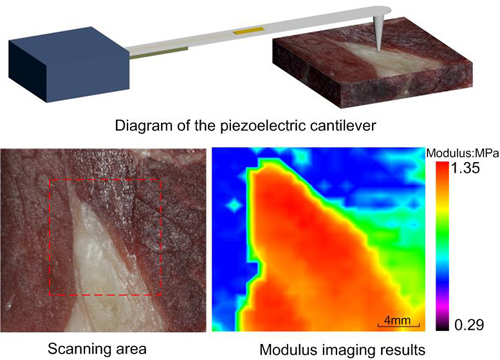
In vitro Elastography results of an bio-tissue indicates that the modulus of fat is about 5 times higher than that of the muscle
Enlightened by the principle of palpation from the traditional Chinese medicine, Professor Li’s group used a self-exciting and self-sensing piezoelectric unimorph cantilever to act as the “hand of physicians” to detect the stiffness of the tissues. By tracking the contact resonance frequency of the cantilever, the modulus of the tissue can be obtained. The repeatability and the sensitivity of this novel method are much better than palpation as it is quantitative. The performance of this elastography method is validated by imaging on bio-samples and phantoms with prefabricated lesions, and the detecting depth can reach over 30mm. This novel elastography system can be regarded as a sensitive palpation robot which is very intuitive and can be used by the physicians or suspected patients for early diagnosis of tumours in superficial organs such as breast and thyroid. Currently, the group is investigating the potential applications of this novel elastography method on clinical diagnosis.
This research also indicates that solid mechanics can play an important role in medical field.