-
[ March 06, 2014]
Professor Long Wang’s group makes new progress in evolutionary dynamics
-
Recently, a new progress has been made by Professor Long Wang’s research group in College of Engineering (COE), Peking University, in the area of evolutionary game dynamics. They explored the characters of aspiration-driven self-learning dynamics in multi-player evolutionary games. This work laid the theoretical foundation of such subject. The research paper was published in Journal of the Royal Society Interface entitled “Aspiration dynamics of multiplayer games in finite populations”. The corresponding author is Professor Long Wang. The first author is Jinming Du, a PhD student in COE, Peking University. The collaborators include Dr. Bin Wu at Max Planck Institute for Evolutionary Biology, Germany and Dr. Philipp M. Altrock at Harvard University, USA.
(Du, J., Wu, B., Altrock, P. M., Wang L. 2014 Aspiration dynamics of multiplayer games in finite populations. J. R. Soc. Interface 11: 20140077. http://dx.doi.org/10.1098/rsif.2014.0077)
Evolutionary game theory not only provides a platform for explaining biological problems of frequency-dependent fitness and complex individual interactions, such as cooperation and coordination. On studying strategy update rules in the framework of evolutionary game theory, one can differentiate between imitation processes and aspiration-driven dynamics. Deterministic and stochastic models of imitation dynamics have been well studied in classical evolutionary games theory. For aspiration dynamics, especially its impact in well-mixed populations—a baseline case for understanding strategy selection—is still lacking sufficient understanding.
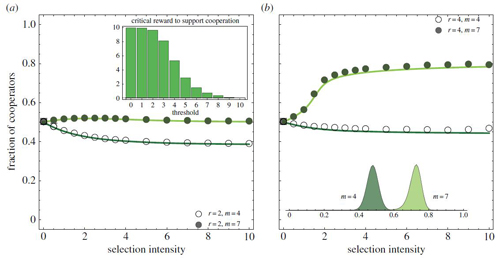
Wang’s group explored how aspiration-driven strategy-update dynamics under imperfect rationality influence the average abundance of a strategy in multi-player evolutionary games with two strategies. They analytically derived a condition under which a strategy is more abundant than the other in the weak selection limiting case. They also explored strong selection numerically, which shows that their weak selection condition is a robust predictor of the average abundance of a strategy. The condition turns out to differ from that of a wide class of imitation dynamics (such as Moran process and pair-wise comparison process), as long as the game is not dyadic. Therefore, a strategy favored under imitation dynamics can be disfavored under aspiration dynamics. This does not require any population structure, and thus highlights the intrinsic difference between imitation and aspiration dynamics.
The results could have potential applications in biology, complex system science, socio-economics, information science, and etc. Particularly, during the rapid and sustained development of the network and intelligent system control theory, the distributed control for agents is believed more promising. Unlike imitation processes of pair-wise comparison, aspiration-driven updates have the advantage of not requiring additional information about the strategic environment and thus being interpreted as more spontaneous. Models similar to the one presented by Wang’s group may be used in attempts to predict human strategic dynamics. Such predictions are essential to our fundamental understanding of complex economic and social behavior and may guide statistical insights to the effective functioning of the human mind.
The research is supported financially by the National Natural Science Foundation of China (NSFC). Journal of the Royal Society Interface is the Royal Society (UK)'s famous cross-disciplinary publication promoting research at the interface between the physical and life sciences. It covers a diverse range of topics, including natural science, mathematics, materials, computer science, medical physics, bioengineering and so on.