
-
[ Janurary 20, 2015]
Prof. Yanfeng Zhang makes progress in the research of monolayer MoS2 growth on Au foils and on-site domain boundary imaging
-
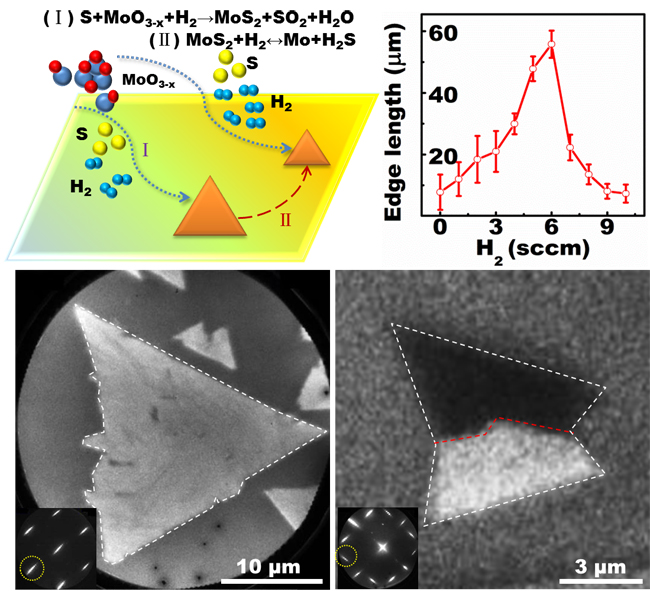 Recently, the research team led by Prof. Yanfeng Zhang from the Department of Materials Science and Engineering, College of Engineering at Peking University has made an important progress in controllable growth of monolayer MoS2 and on-site domain boundary imaging. The results titled “Monolayer MoS2 Growth on Au Foils and On-Site Domain Boundary Imaging” have been published as the inside cover in the famous journal Advanced Functional Materials (DOI: 10.1002/adfm.201403659).
Monolayer transition metal dichalcogenides (TMDCs), which consist of two close-packed chalcogenide planes sandwiching a transition metal layer in a trigonal prismatic X-M-X configuration, have recently attracted enormous attentions in nanoelectronics, valleytronics, optoelectronics, and hydrogen evolution reaction (HER). However, controllable synthesis of large domain monolayer MoS2 (a member of TMDCs) is a prerequisite for fulfilling these application potentials. Herein, by introducing H2 as carrier gas, the research team has successful synthesis of large domain monolayer MoS2 triangular flakes on Au foils, with the edge length can be tunable from several microns to several tens microns. Even larger domain flakes (edge length of ~ 81 μm) and near complete MoS2 films are achieved. The growth process is proposed to be mediated by two competitive effects with H2 acting as both a reduction promoter for efficient sulfurization of MoO3 and an etching reagent of resulting MoS2 flakes. By using low-energy electron microscopy/diffraction, the crystal orientations and domain boundaries of MoS2 flakes directly on Au foils for the first time are further identified. These on-site and transfer-free characterizations should shed light on the initial growth and the aggregation of MoS2 on arbitrary substrates, further guiding the growth toward large domain flakes or monolayer films.
The first author of this article is Jianping Shi, the Ph. D. candidate.
The collaborators of this article are Professor Zhongfan Liu from College of Chemistry and Molecular Engineering at Peking University and Professor Xinhe Bao, Professor Qiang Fu from Dalian Institute of Chemical Physics at Chinese Academy of Sciences.
This work was financially supported by National Natural Science Foundation of China (Grants Nos. 51222201, 51290272, 21201012, 51121091, 51072004, and 21222305) and the Ministry of Science and Technology of China (Grants Nos. 2011CB921903, and 2012CB921404).