
-
[ February 15, 2015]
Penta-graphene: A new carbon allotrope discovered
-
Recently, a new progress has been made by Prof. Qian Wang’s group at the Center for Applied Physics and Technology (CAPT), College of Engineering, Peking University, and her collaborators in simulated synthesis of a graphene alternative: Penta-graphene. This work is published in the Early Edition of Proceedings of the National Academy of Sciences of the United States of America (PNAS) http://www.pnas.org/content/early/2015/01/27/1416591112, and featured on “New & Newsworthy” and the “In This Issue” by PNAS.
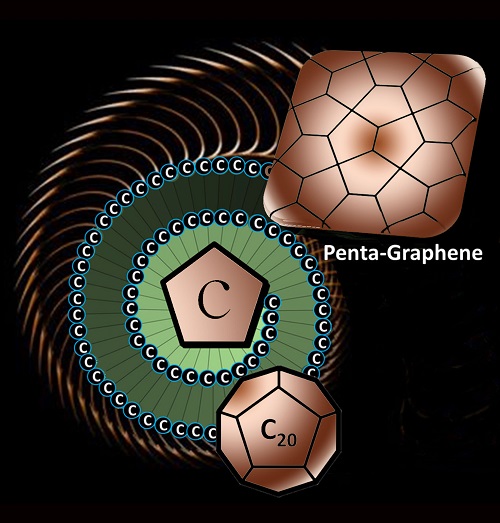
Carbon is an amazing material: it not only forms the chemical basis for all known life but also, because of its flexibility in chemical bonding, displays many faces: from the well-known graphite, diamond, C60 fullerene, nanotube and graphene to the newly discovered carbon nanocone, nanochain, graphdiyne, as well as the three dimensional metallic carbon. Whereas hexagons are the primary building blocks of many of these materials, except for C20 fullerene, carbon structures made exclusively of pentagons are not known. Wang and co-workers predicted, based on a variety of state-of-the-art theoretical calculations, the existence of an all-pentagon nanosheet, named penta-graphene, which would be thermally stable, withstanding temperatures up to 1000 K.
The authors found that penta-graphene has unusual properties such as a negative Poisson’s ratio (namely, if stretched on one axis, the sheet expends on the one perpendicular to it as well), a large band gap and an ultra-high ideal strength that can even outperform graphene. Thus, there is no need to functionalize penta-graphene for opening the band gap as is the case with graphene. More interestingly, penta-graphene can be rolled up to form a one-dimensional pentagon-based nanotube that is semiconducting regardless of its chirality. Therefore, there is no need to develop special techniques to separate semiconducting nanotubes from the metallic ones as is the case with conventional carbon nanotubes. In addition, penta-graphehe can also be stacked to form three dimensional stable structures displaying different properties from those of the mother-phase T12-carbon. The versatility of penta-graphene and its derivatives are expected to have broad applications in nanoelectronics and nanomechanics.
Penta-graphene is a novel concept, which is quoted in Wikipedia
http://en.wikipedia.org/wiki/Penta-graphene, and has caught a lot of media attention such as:
http://scitation.aip.org/content/aip/magazine/physicstoday/news/10.1063/PT.5.7145
http://www.rsc.org/chemistryworld/2015/02/calculations-predict-pentagonal-graphene
http://www.materialstoday.com/carbon/comment/flatpacked-pentagonal-carbon/
http://www.chemistryviews.org/details/news/7470031/Penta-Graphene.htmlThe first author of this paper is Mr. Shunhong Zhang, a PhD student at the CAPT, the corresponding author is Prof. Qian Wang at the CAPT. The collaborators include Dr. Jian Zhou and Prof. Puru Jena at Virginia Commonwealth University (USA), Prof. Xiaoshuang Chen at Shanghai Institute of Technical Physics of the Chinese Academy of Sciences, and Prof. Yoshiyuki Kawazoe at Institute for Materials Research, Tohoku University (Japan). This work is supported by grants from the National Natural Science Foundation of China, the Foundation of National Laboratory for Infrared Physics, Shanghai Institute of Technical Physics of the Chinese Academy of Sciences, and the National Grand Fundamental Research 973 Program of China.
Credit: Qian Wang?Center for Applied Physics and Technology?Peking University