
-
[ March 01, 2015]
Qiushi Ren elected as SPIE Fellow
-
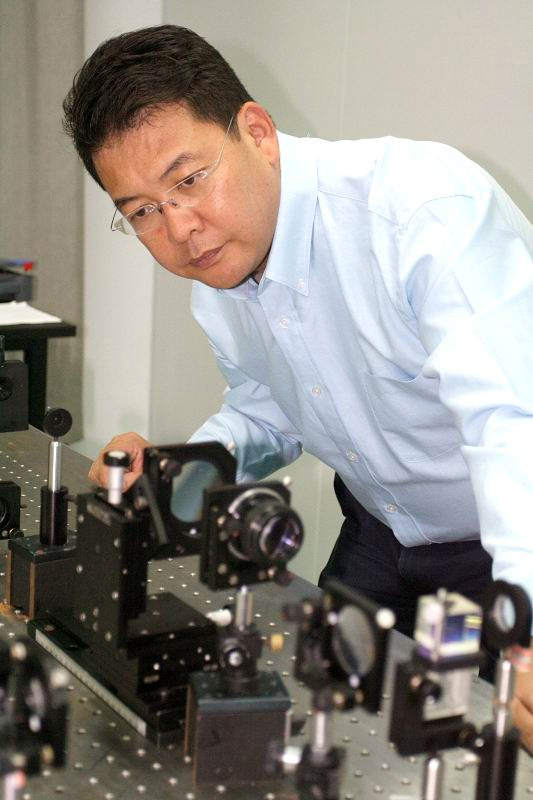 According to an announcement made by the Society of Photo-Optical Instrumentation Engineers (SPIE) recently, Professor Qiushi Ren of the Department of Biomedical Engineering, College of Engineering, Peking University will be promoted as a SPIE Fellow this year.
SPIE is the international society for optics and photonics, a not-for-profit organization founded in 1955 to advance light-based technologies. The Society serves more than 235,000 constituents from approximately 155 countries, offering conferences, continuing education, books, journals, and a digital library in support of interdisciplinary information exchange, professional growth, and patent precedent.
SPIE said it will promote 58 new Fellows of the Society this year, to recognize the significant scientific and technical contributions of each in the multidisciplinary fields of optics, photonics, and imaging. SPIE Fellows are honored for their technical achievements and for their service to the general optics community and to SPIE in particular. More than 1,000 SPIE members have become Fellows since the Society’s inception in 1955.
The annual recognition of Fellows provides an opportunity for SPIE to acknowledge Members for their outstanding technical contributions and service to SPIE.
Qiushi Ren, Peking University, China, was recognized for achievements in ophthalmic and molecular imaging technology.
Ren has made significant contributions to the field of ophthalmic and molecular imaging technology by developing a wide-range of methodologies and applied them to studies of major diseases. He was the first to demonstrate that the 213nm laser wavelength generated by 5th harmonic of Q- switched Nd:YAG laser could be a solid-state laser alternative to excimer laser for corneal refractive surgery. In addition, he has successfully designed a hybrid system that integrates PET, CT, SPECT and optical multimodality imaging system for small animal studies. He discovered the mechanism of skin collagen organizational restructuring and regeneration by laser technology through physical regulating. Furthermore, his team developed a series of related medical equipment, successfully realized industrialization. Ren has also established strong collaborations with many top hospitals across several major cities in China such as Peking University Hospitals in Beijing and Ruijing Hospital in Shanghai.
As a major contributor to the field of biomedical engineering in general and to biophotonics, molecular imaging, and neural engineering in particular, Ren has published over 120 peer-reviewed journal papers, co-edited 3 proceeding books, and filed 2 US patents and over 40 Chinese patents. Under his leadership, the Department of Biomedical Engineering of Engineering School at Peking University has built a strong and comprehensive partnership with the Department of Biomedical Engineering at Georgia Institute of Technology and Emory University, leading to the establishment of a unique joint and global PhD program. A total 40 graduate students from both countries have enrolled in this program during the past 4 years.