
-
[ March 04, 2015]
Dr. Junjie Yao from Washington University gives a seminar in College of Engineering
-
On March 2, 2014, invited by the Department of Biomedical Engineering, Dr. Junjie Yao who worked in the Department of Biomedical Engineering at Washington University, St. Louis, gave a seminar entitled “New Dimensions in Photoacoustic Imaging” at Peking University. Prof. Changhui Li hosted this event.
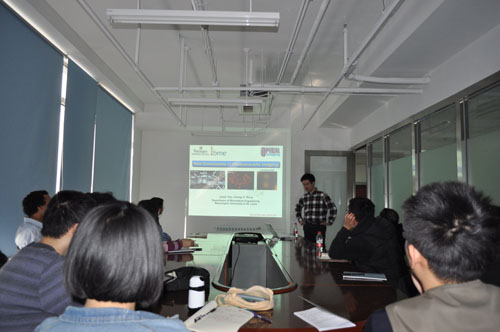
In his talk, Dr. Yao gave a comprehensive introduction on recent progresses of photoacoustic imaging. Firstly, he demonstrated a photoacoustic microscopy method, a novel Microelectromechanical system (MEMS) based on immersive scanning mirror. By applying the pulse-width-based single wavelength approach, this ultra-fast photoacoustic imaging technique has achieved a 1D oxygenation imaging rate of 100 kHz. This work allowed label-free imaging of the mouse brain activity with high spatial-temporal resolution in a wide field of view. Then, he talked about a new super-resolution photoacoustic imaging method based on non-linear photobleaching or photo-switching dynamics. With this new method, the spatial resolution has been improved up to 80 nm. In addition, with the aid of a reversibly switched protein BphP1, early-stage cancer imaging can be made at >7mm in tissues. In the end of his seminar, Dr. Yao talked the thermal diffusion tensor imaging based on photoacoustic method, and envisioned its potential biomedical application in future.
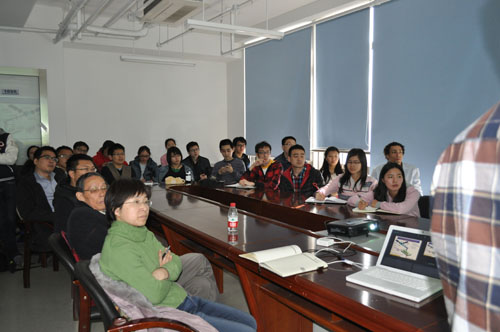
Faculties and students from different departments attended this seminar. The audiences asked many questions and discussed with Dr. Yao after his talk. They expressed that this lecture was impressive and great helpful for their further study.
Dr. Junjie Yao’s research interest is novel photoacoustic, optical, and ultrasound imaging technologies in biomedicine. In the past six years, he has published more than 50 peer-reviewed journal articles, including Physical Review Letter and Nature Method, and two book chapters. He (co-)invented photoacoustic Doppler-bandwidth flowmetry, photoacoustic oxygen metabolic microscopy, and photo-imprint super-resolution photoacoustic microscopy.