
-
[ Janurary 22, 2016]
Super-resolution deep imaging achieved by Dr. Peng Xi and collaborators
-
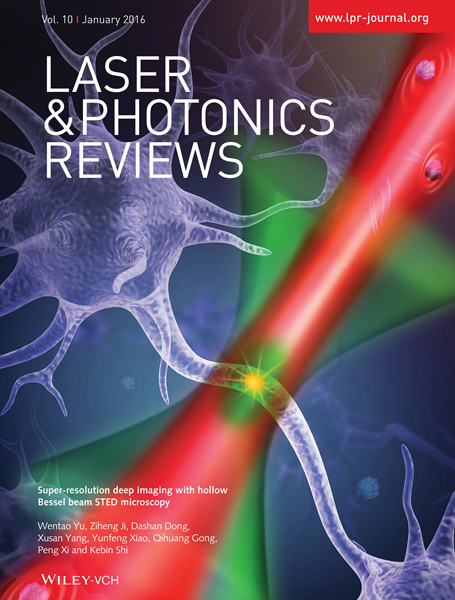 Super-resolution technology has won 2014 Nobel Prize in Chemistry. A series of novel super-resolution imaging technologies have been proposed in recent decades, which can help scientists in distinguishing the objects with size less than diffractive limit, and further in laser precision processing and high-density optical data storage. Stimulated emission depletion (STED) microscope is one of the most important super-resolution imaging technologies which brings super-resolution imaging by modulating the emission spot. However, the aberration and scattering makes it very difficult for conventional STED microscopy to maintain consistent super-resolution inside the specimens due to aberration and scattering distortion. Recently, a group led by Dr. Kebin Shi and Prof. Qihuang Gong from School of Physics, and Dr. Peng Xi from College of Engineering, Peking University have made important progress in deep STED super-resolution imaging. This new result has been published in Laser & Photonics Reviews as a cover paper (DOI: 10.1002/lpor.201500151).
In this work, the group has modulated the depletion beam into a first-order hollow Bessel beam to contain the doughnut-shaped focused spot and remained a conventional Gaussian beam for excitation. Taking advantage of the anti-diffractive and self-healing nature of Bessel beam, it has achieve deep super-resolution imaging in brain tissue phantom. The improved STED microscopy could maintain the resolution of 112 nm at the depth of 97 μm, which was improved by twice compared with conventional STED. Besides, Gauss-Bessel STED microscope is a fully automatic and rapid method for deep super-resolution imaging compared with using the corrected collar on the objective lens to compensate the aberrations, which is empirical and time consuming.
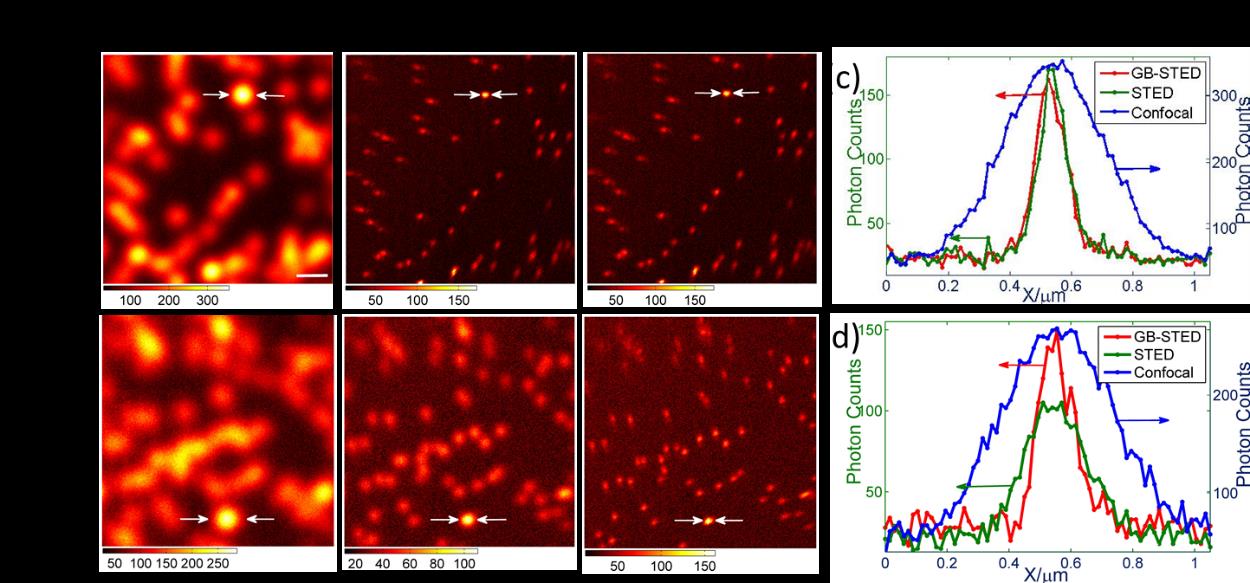
Fig. 1 Images from the brain gray matter phantom via confocal, STED and GB-STED.
Wentao Yu in Dr. Kebin Shi group from School of Physics is the first author of this article, and Dr. Kebin Shi and Dr. Peng Xi are the co-corresponding authors. This work is supported by the National Basic Research Program of China and National Science Foundation of China.
Link:
http://onlinelibrary.wiley.com/doi/10.1002/lpor.201500151/abstract