-
[ October 24, 2011]
[2011 GEDC Conference Special] Academic-Corporative Cooperation & Globalization
-
The 2011 GEDC Conference plenary speech session was held at Peking University on the October 22. Speakers from institutions and industry delivered speeches from varying perspectives on the role of engineering education in the world.
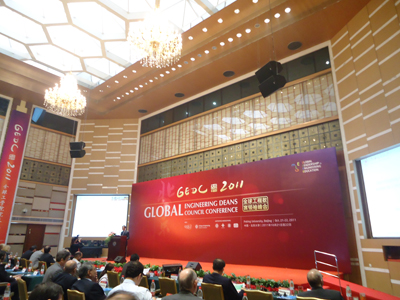
The four speakers: Shanghai Jiaotong University President Jie Zhang, Schneider Electric Power Business Executive Vice President Eric Rondolat, University of Southern California Viterbi School of Engineering Dean Yannis C. Yortsos and National University of Singapore Research Strategy Vice President Seeram Ramakrishna shared a common concern. They regard the connection between university and industry as essential; thus, technological development and the innovative power of engineering schools should be efficiently channeled into economic and social development.
Sarah Rajala, incoming chair of GEDC, served as moderator for this session. She began by expressing her hope to engage all participants in the exchange of ideas in this session and wished all to enjoy their academic interaction. She then introduced and welcomed Zhang to the podium.
Zhang’s speech focused on the engineering education in China. He addressed the importance of engineering education: “Scientist[s] seeks to understand what is; Engineer[s] seek [to] create what never was.”
Although China has achieved rapid economic growth since the 1980s, its economy mainly depends on cheap labor and high resources consumption, according to Zhang. China is currently in the transitional period between being a factor-driven nation and an efficiency-driven nation. In this special period, it is a strategic option to build an innovation-oriented industry, which poses challenges to Chinese engineering education. Therefore, Chinese universities should shoulder the responsibility of developing diversified modes of industry-university research cooperation, with “market” as the bridge between innovation and profit.
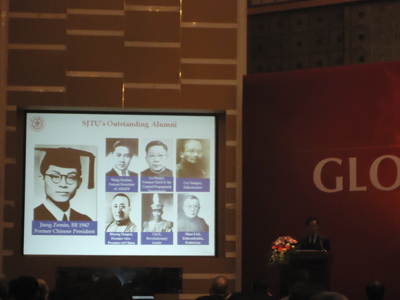
Jie Zhang's speech
Rondolat continued the discussion from a corporative vision. He presented the current energy dilemma, which calls for cleaner energy and higher energy consumption efficiency. Rondolat emphasized the importance of incorporating students into the R&D stage of industry, since they are part of the generation that must find a resolution to the energy crisis.
With specific programs of Schneider Electric, Rondolat demonstrated that the cooperation between university and corporations is a win-win relationship.

Eric Rondolat's speech
Yortsos moved the discussion to engineering education in a hyper-connected world. Global challenges require global collaboration, Yortsos said. USC is already part of a collaborative sharing system through the “i-Podium” system, a joint venture with PKU and National Taiwan University that allows students to have access to the same classroom via online sharing.
Outside of the academic world, the new global economy will lead to the elimination of routine jobs and appearance of creative jobs based on innovation and entrepreneurship, Yortsos said.
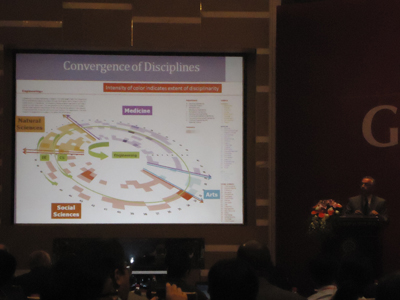
Yannis C. Yortsos's speech
At last, Ramakrishna delivered his speech on the role of GEDC in a hyper-connected, independent, competitive world. He touched on GEDC’s history and progression over the years, mentioning its initiative and support from global political leaders. Still, he said that engineering school leaders face challenges and GEDC still has a long way to go.
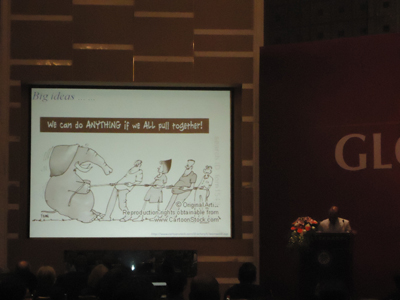
Seeram Ramakrishna's speech
Additional Information on the Speakers:
Jie Zhang, President, Shanghai Jiaotong University
Jie Zhang took office as the 39th president of Shanghai Jiao Tong University on November 27, 2006. He is a physicist in x-ray lasers, high field and laser-plasma physics; he was elected academician of the Chinese Academy of Sciences (CAS) in 2003, a member of German Academy of Sciences Leopoldina in 2007, Fellow of Third World Academy of Sciences (TWAS) in 2008, and International Fellow of the Royal Academy of Engineering in 2011. He was elected as an alternative member of the Central Committee of Chinese Communist Party in 2007.
Eric Rondolat, Executive Vice-President, Power Business, Schneider Electric Asia-Pacific
Eric Rondolat’s career has mainly had an international focus. He has completed a master’s in international marketing and is a graduate from ENSEEG .He was nominated Country Manager of Schneider Electric Argentina, Uruguay and Paraguay until 2003. He moved back to France in 2004 to become Senior Vice President in the Customers and Markets Division, responsible for the strategic marketing of panel builders, contractors, electric utilities and building, energy and infrastructure markets. He is currently the executive vice president of Power Business in Schneider Electric.
Yannis C. Yortsos, Dean of the Viterbi School of Engineering at the University of Southern California
Yannis C. Yortsos is dean of the Viterbi School of Engineering at the University of Southern California, the Chester F. Dolley Professor of Chemical and Petroleum Engineering, and holder of the Zohrab A. Kaprielian Dean’s Chair in Engineering. He was appointed dean in 2005. Yortsos previously served as senior associate dean for academic affairs at the Viterbi School from 2001 to 2005. He was chairman of the USC Department of Chemical Engineering from 1991 to 1997. Yortsos received his B.Sc. degree from the National Technical University, Athens, Greece, in 1973, and M.Sc. and Ph.D. degrees from the California Institute of Technology in 1974 and 1979 respectively, all in chemical engineering. Yortsos is a member of the U.S. National Academy of Engineering, a Foreign Member of the Russian Academy of Natural Sciences and the recipient of a number of awards, including most recently Honorary Member of the Society of Petroleum Engineers (SPE) (2011) and Honorary Member of the AIME (2011). He was the SPE Editor-in-Chief for all technical journals of the SPE from 2006-2010. He currently serves on the Executive Committee of the Engineering Deans Council as well as on the Executive Committee of the Global Engineering Deans Council. His research interests are in the flow, transport and reaction processes in porous media and constricted flow geometries.
Seeram Ramakrishna, Vice President, Research Strategy, National University of Singapore
Seeram Ramakrishna, FREng, FNAE, FAAAS is the author of the book “The Changing Face of Innovation”. He is an advisor and sought after speaker on global trends of higher education, scientific research, and innovation. He participates in round table discussions organized by various think tanks including the World Bank, OECD, and ASEAN. He was trained as a materials engineer at the University of Cambridge, and received general management training from the Harvard University. Thomson Reuters ISI Web of Knowledge places him among the top one percent of materials scientists worldwide (ESI rank is 30). He is an elected international fellow of major engineering societies in Singapore, ASEAN, India, UK and USA. He is a professor at the National University of Singapore and held several senior leadership positions which include Dean of Engineering, Vice-President of research strategy, Vice-President of International Federation of Engineering Education Societies, and Founding Chair of Global Engineering Deans Council. His passion led to substantial academic partnerships with institutions such as MIT, UC Berkeley, University of Cambridge, Imperial College, French Grand Ecoles, TUM, ETH, Technion, Peking University, and IITs in healthcare, energy, water and sustainability.
***
Source: PKU English News