
-
[ October 24, 2011]
[2011 GEDC Conference Special] New Dean Mentoring
-
The 2011 Global Engineering Deans Council (GEDC) Conference held a “New Dean Mentoring” session on October 22 at Peking University.
The session was chaired by Sarah Rajala, dean of the Mississippi State University engineering school; David Munson, dean of the University of Michigan engineering school; and Diego Hernandez Losada, dean of the National University of Colombia engineering school.
Keynote speakers focused on strategies for new leaders in engineering education.
Losada spoke about his experience as a new dean, introducing financial and essential organization activities of his school that were centered around a message of “commitment to excellence.” He places emphasis on the “internalization” of engineering education and leadership.
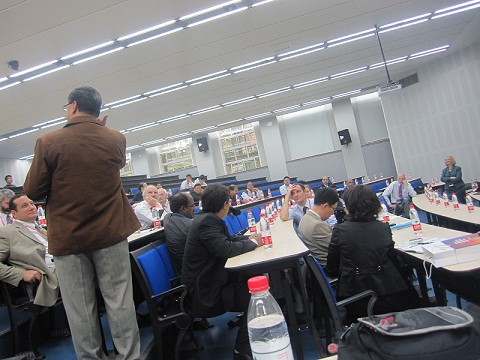
Diego Hernadez Losada answering questions from the audience
Munson followed with a discussion with his views on being an effective new dean. By using his own experience as examples, he explained the ways of dealing with the faculty, staff, students and fundraising.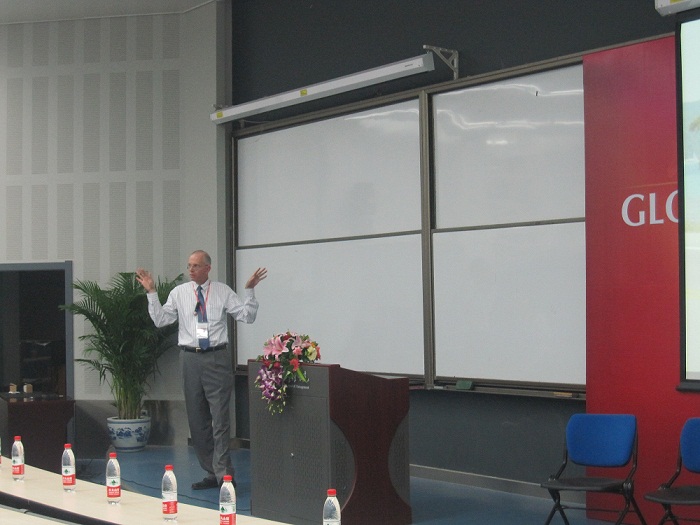
David C. Munson shared his experience
Rajala then shared her experience on strategic planning and educational program assessment. She explained the accreditation system in the U.S. and gave suggestions on how to conduct strategic planning.
The atmosphere of the session was active, especially the Q&A part.
“The exchange of ideas and insights between deans of engineering worldwide is what this conference matters most,” Rajala said.
Munson concurred, adding that it was important to promote cooperation with partners around the world to better understand the future of engineering education.“As a dean, a manager, my job is not teaching, but participating in technical conferences in different cities and countries in globalization,” Munson said.
***
Interview with Sarah Rajala
Q: How do you feel about the role of engineers in this globalized world?
A: Many issues such as clean water and energy are global issues, which require engineers to understand and deal with these problems with a global vision. Also in today’s multi-national companies, you need to work with colleagues from different backgrounds. The products engineers design need to hit the global market to be a success. So I feel that the requirement to be a good engineer has been raised with globalization, and engineers are faced with more difficulties than before.Q: Can you compare the role of scientists and engineers today?
A: Scientists pursue the truth out of their curiosity of nature, while engineers are needed to apply the basic knowledge to tackle practical problems. Engineers also need a good mastery of basics to do a good job so in many cases, scientists and engineers need to work together. I do believe there’s a spectrum, one end of which is pure research while the other end manufacturing. But both scientists and engineers are important, and we need both.Q: As a dean of school of engineering, do you need to get in contact with government a lot?
A: Not that often. The most common thing you need to work out with government is when you ask for grants, from such as federal government, Natural Science Foundation and Department of Energy in the United States, as you know.Q: Do you think it’s a good idea that government has more officials with engineering backgrounds?
A: Yes, I do. You see, in United States we have far too few people working in the government that can understand the complexity of many science and technology issues. It’s best that some of the engineers can also take an interest in public policy.Source: PKU English News