
-
[ October 24, 2011]
[2011 GEDC Conference Special] Bringing Young Mind Power from the Ivory Tower to Industry
-
“Sustainable growth” may seem like an overused term, but it is a topic of increasing concern. The world is facing challenges of constrained natural resources, increasing costs of energy acquisition and consumption, and continuous emissions from global industries with the potential to contribute to climate change.
The 2011 Global Engineering Dean’s Council (GEDC) Conference focused on how engineering education can contribute.
“The solution is a combination of cleaner energy generation and consumption efficiency,” said Eric Rondolat, executive vice-president of Schneider Electric Asia-Pacific’s Power Business unit. “Students are part of the generation to solve these problems.
Rondolat explained energy stakes and explored what it means for universities to educate those who must resolve energy issues. He said Schneider Electric could contribute as a global corporation leader in energy management.
Young minds in industry are of value; Rondolat provided examples of programs designed to promote engagement in industry. At the collegiate level, contests such as “Go Green in the City,” the Solar Decathlon, Green Campus and the Schneider Electric Energy Efficiency Contests are aimed at students interested in exploring potential energy solutions.
By working together at innovative stage of technology, a win-win type of relationship is established: companies get the extra fresh mind power their R&D needs, while students get the opportunity to try themselves out.
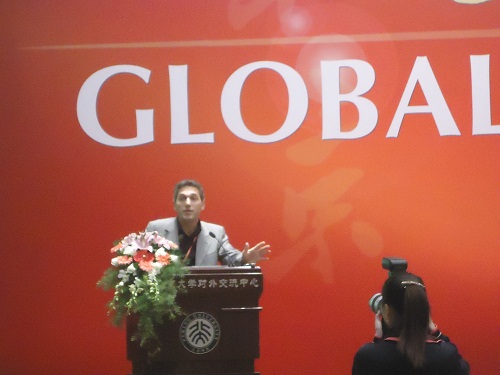
Eric Rondolat
“At [University of Alaska Fairbanks], programs are tailored to help industries,” said Professor Douglas Goering, the CEM Dean at University of Alaska Fairbanks, who was in attendance. “For example, we have a mining engineering program which is not available in all universities, but it corresponds with the specific industrial needs in Alaska, where natural resources like oil are abundant.”
Goering said that it was the university’s regional responsibility to involve industry into its curriculum, but that the government should be the third party.
Usha R. Sharma, government commissioner and secretary of the government of Punjab, India, confirmed the need for engineering education to meet the needs of industry. She pointed out that the key word of higher education in India is “employability”.
“Industries set up the requirements and universities design courses to meet them. In this way, university graduates would have no problem finding a good job in the industry, which will help them become better and happier citizens,” Sharma said.
Both China and India are transitional countries with a high growth rate; in order to facilitate growth, education must focus on educating competent young professionals for the industry, Sharma continued.
*Source: PKU English News