
-
[ February 10, 2012]
Peking University President Qifeng Zhou visits COE Shaoxing Institute of Technology
-
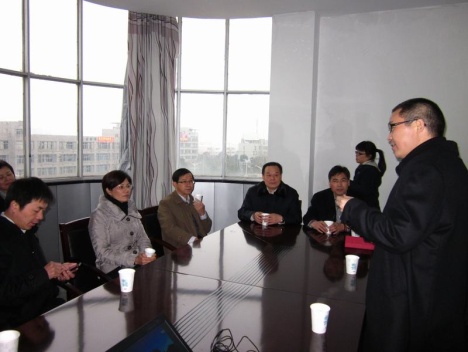 A delegation headed by Peking University President Qifeng Zhou visited the College of Engineering (COE) Shaoxing Institute of Technology (SIT), a COE-Shaoxing co-established research institution located in Zhejiang Province, on February 4. After visiting the laboratories of energy technology and biotechnology, and hearing an overall report made by SIT Director Duoxiang Wang, Zhou recognized SIT’s achievements and encouraged SIT to integrate more closely with Peking University as well as to contribute more to the local economy.
SIT was founded in 2008 to facilitate the industrialization and transfer of COE’s advanced technologies in some of the areas that the country has the most pressing needs, such as environment, energy, materials, electronics and apparatus. The Shaoxing local industry serves as the industrialization outlet. Thus, SIT has a dual responsibility: to help COE achieve one of its missions of “becoming a world-class research center that is devoted to the discovery and application of new knowledge in engineering and science” as well as to boost the industrial, economic and social development of Shaoxing.
In the last three years, with the support from both sides, SIT has achieved substantial development, Wang said.
It now has 25 full time employees and 16 graduate students. Four research groups in energy, biotechnology, apparatus and information technology have been formed. The research staff has successfully launched 26 projects, among which six have been accomplished. Ongoing projects include the efficient preparation of sucrose esters, natural salty flavor preparation, improving solar water heating systems, the development of rapid non-invasive diagnostic apparatus of tumor, 3g / internet-based video information system and others. The institute has also accumulatively filed 16 patent applications and six have been granted. Wang reported to the delegation.
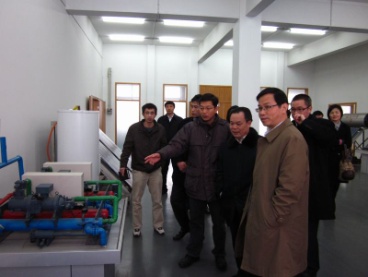 The laboratory of the energy technology is one of the key labs of SIT, which is led by COE Professor Xinrong Zhang, who has over a decade research experience in thermal fluids. Zhang demonstrated their newly-designed innovative solar water heating system called BD-1, which outdoes the products in the current market. BD-1 could enhance the normal thermal efficiency by 15 percent and produce water at higher temperature (60-90 degrees centigrade). It also has low cost and good adaptability in cold area environment. The prototype has already been completed and ready for industrialization. Other research projects include hot air solar energy, heat pump energy-saving core technology, heat storage system, mid/low temperature sludge drying, and non-compressed air-conditioning etc.
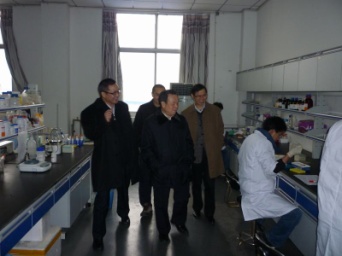 Zhou also visited the laboratory of biotechnology, which aims to develop new technologies, methods and products in the fields of biological engineering, fermentation engineering, and medical engineering. With a spacious lab area of 500 square meters, equipment worth 4 million RMB and four research teams in molecular biology, cell biology, fermentation engineering and organic chemical synthesis, it has high potential to become a training base for high technology talents, a birthplace of high-tech products and an effective local economy contributor.
Zhou expressed satisfaction of what SIT has achieved in a short time. “COE endeavors to become a college of engineering with its own characteristics. I highly agree with that. It has decided to open the system of technology and entrepreneurship to all units of the school, which I think is a good decision,” Zhou said.
SIT should continue to strengthen the relationship and integration with Peking University, to form a unique competitiveness via linking with other research bodies at PKU, and thus to make greater contributions to the local economy and society, Zhou added.
Shihao Sheng, vice Mayer of Shaoxing government and Liming Yu, director of the Science and Technology Department of Shaoxing also attended the meeting.