
-
[ December 25, 2011]
Academician Xiantu He publishes research progress on Physical Review Letters
-
Recently, Prof. Xueqing Yan, Academician Jia-erh Chen and Academician Xiantu He from the School of Physics and the College of Engineering, Peking University, proposed laser driven plasma lens for profile shaping of laser pulse and published their paper “Laser Shaping of a Relativistic Intense, Short Gaussian Pulse by a Plasma Lens” on Physical Review Letters(PRL 107, 265002 (2011)).
Ultrahigh-intensity lasers can produce accelerating fields of TV/m, surpassing those in conventional accelerators for ions by few orders of magnitude. Remarkable progress has been made in producing laser-driven ultra-bright MeV proton and ion beams in a very compact fashion compared to conventional RF accelerators. These beams have been produced up to several MeV per nucleon with outstanding properties in terms of transverse emittance and current, but typically suffer from exponential energy distributions. Phase Stable Acceleration (PSA) can generate the mono-energetic and collimated ion beam and is one of the most promising mechanisms for ion acceleration. Theoretical study shows that the required medical proton/carbon beams (200MeV for proton and 400MeV/u for Carbon) can be generated from hydrogen/carbon foil (sub micron) in a laser intensity of ~10^21/10^22W/cm2, while ultra high laser contrast (10^10) is required to avoid the pre-expanding of the thin foil.
Both ultra-high laser intensity and ultra-high laser contrast are challenging for state of art laser technology. In this letter, the near-critical density plasma is firstly used as optical unit to focus, clean and steepen the laser pulse with relativistic intensity. The referee comments that “The present work undoubtedly breaks new ground and is of interest to many physicists.”The plasma lens will be a key unit for the laser ion accelerator in the near future.
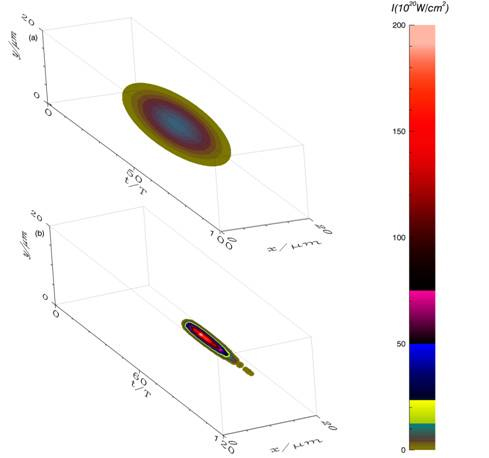
Fig.1 Energy distribution in 3D space(upper) and after shaping by the laser plasma lens (down)This work was supported by National Natural Science Foundation of China (Grant Nos. 11025523, 10935002, 10835003) and National Basic Research Program of China (Grant No. 2011CB808104). Financial supports also come from Key Lab of High Energy Density Physics Simulation (CAPT).