
-
[ February 22, 2012]
NUS Professor Loon Ching Tang lectures on frontier research in industrial engineering
-
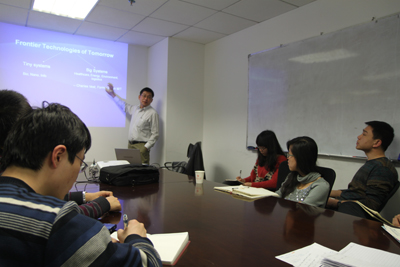 Loon Ching Tang, professor and head of the Department of Industrial & Systems Engineering (ISE) at the National University of Singapore (NUS), gave a lecture on frontier research in industrial engineering (IE) on February 21 in the Department of Industrial Engineering and Management (IEM), College of Engineering, Peking University.
Professor Tang has been head of ISE for five years. His research areas are in applied probability and statistics, Six Sigma, operational research, queuing and its applications. He said he believed that healthcare, energy, manpower and ports systems would become major hot areas for industrial engineering education and research.
In the last 10 years, people’s lives have been transformed by factors such as climate change and escalating healthcare cost. As industrial engineering education and research are typically motivated by real-world issues, there is a sweeping change from focusing on traditional methodologies to areas related to complex systems, Tang said.
Tang commented on the important role of a nation’s economic structure as it develops. In the U.S., service systems including finance and business, hospitality, public services and logistics, have contributed 88 percent to its GDP.
Tang explained that research on system optimization of these major service sectors would substantially promote a nation’s development.
The percentage of GDP spent on healthcare in a nation is a statistic worth noting. Other research topics include energy pricing and regulations to induce desired behaviors for sustainable development, education and migration policies for sustaining long-term economic growth, and the layout of sea and air ports to facilitate international trade.“These perspectives reflect the frontier in industrial engineering,” said Zhe Liang, assistant professor of IEM, who invited Tang to give this lecture. “I think the lecture has helped our students broaden their views.”