
-
[ February 27, 2012]
COE professors spur low carbon research
-

Several researchers from the College of Engineering (COE) officially launched their Singapore-based research center, SPURc, after their detailed research plan got approved at the first SPURc Steering Committee meeting held on February 24 at Peking University.
SPURc is abbreviated for “Singapore-Peking University Research Centre for a Sustainable Low-Carbon Future,” which is located in Singapore and funded by Singapore National Research Foundation (NRF). The center is home to professors from PKU, Nanyang Technological University (NTU) and National University of Singapore (NUS), where they focus on carbon dioxide capture and conversion research.
Its successful launch has been greatly supported by NRF and COE. NRF Planning & Policy Director George Loh discussed with COE Dean Shiyi Chen the overall management of the project at the meeting. They expressed concern about the large-scale carbon dioxide emissions in both countries and said they hoped researchers from the three universities would cooperate to combat global warming.
The COE team is cross-disciplinary, including Professor Steven Feng Chen from the Department of Energy and Resources Engineering (ERE), who is also the program director, Professor Qiang Sun from the Department of Materials Science and Engineering (MSE), and Associate Professor Ruqiang Zou co-affiliated with ERE and MSE, together with Professor Kai Wu from College of Chemistry. Professor Dongxiao Zhang, executive vice dean of COE, is also a key member of the team and is serving as chair of the Management Committee.
In the next five years, they will collaborate with other investigators from NTU and NUS. They plan to recruit over 30 Ph.D. students and postdoctoral fellows in the next two years.
The SPURc team is the first international research group set up by a Chinese university under Singapore's NRF Campus for the Research Excellence and Technological Enterprise (CREATE) initiative. NRF has allocated lab and office space for the research center. At the meeting, the Steering Committee approved S$5.495 million for its first year budget.
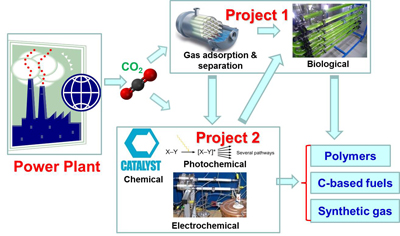 The goal of SPURc is to separate and capture CO2 from power plant emissions and and convert it to useful chemicals and fuels. Four routes will be taken including physical, biological, photochemical and electrochemical.
The physical sub-team will try to achieve physical CO2 capture and separation using porous materials and hydrate, while the biological sub-team attempts to remove CO2 by genetically modified microalgae to produce algal oil and high-value products. The chemical route is to develop novel catalysts to achieve thermal or photo conversion of CO2 to fuels in a cost-effective manner, and the electrochemical approach is to convert CO2 into synthetic gas, which is a building block for chemical fuels.
Both COE and NRF believe that the research will extend their knowledge and capability in low carbon technology research and will help Singapore and China achieve their goals of carbon dioxide reduction.
About NRF CREATE
CREATE (Campus for Research Excellence And Technological the Enterprise) is a major international cooperative initiative set up by the National Research Foundation (NRF) of the Singapore Prime Minister's office. The program aims to attract the world's elite professors and institutions to collaborate with local universities and research institutes to co-found high-tech research centers.CREATE has established nine joint research centers, including SPURc. Other research centers have been set up by researchers from universities such as Massachusetts Institute of Technology (MIT), University of California-Berkeley and the Swiss Federal Institute of Technology (ETH).