
-
[ March 29, 2012]
PKU Center for Water Research holds on Distributed Temperature Sensing (DTS) workshop
-
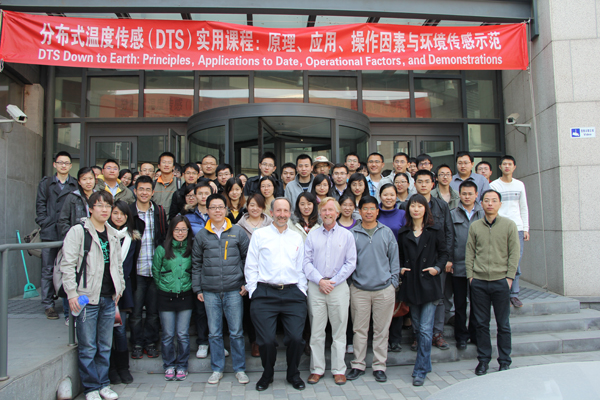
On March 26-27, Peking University Center for Water Research hosted a workshop on Distributed Temperature Sensing (DTS) techniques called “DTS Down to Earth: Principles, Applications to Date, Operational Factors, and Demonstrations.”
Professor John Selker from Oregon State University and Professor Scott Tyler from University of Nevada, Reno, two world-renowned experts on DTS application and other environmental sensing techniques in hydrological sciences, presented an overview of DTS.
DTS is the measurement of temperature using only the properties of a fiber optic cable. It can measure temperature every 0.25-2 meters for as long as 30km, every second-60 minutes, with temperature resolution of 0.03-0.50C.
Compared to traditional temperature sensing techniques, DTS has many advantages. Fiber optic cable is relatively inexpensive ($0.10-$10/meter), robust and has small thermal inertia. Once installed, continuous measurements do not disturb the fluid column or soils.
In recent years, this method is gaining favor among many experts and scholars in ecology, hydrology and biology. It is widely used in oil/gas, electric transmission line monitoring and surface water/ground water interactions.Professor Chunmiao Zheng, director of the Center for Water Research and organizer of this workshop, said he sees the potential role of DTS in solving groundwater management problems.
“Due to the temperature difference of surface water and groundwater, there will be a temperature change when they interact. By laying the DTS cables at the bottom of a river, we can locate where the two meet,” Zheng said.