
-
[ April 12, 2012]
Semiconducting minerals may help non-phototrophic microorganisms harness solar energy
-
An interdisciplinary research team led by Peking University professors has discovered a novel pathway for micro-organisms to convert solar energy to chemical energy. They proved that non-phototrophic micro-organisms have the capability of harvesting solar energy with the help of semiconducting minerals. Their findings were published on Nature Communications on April 3.
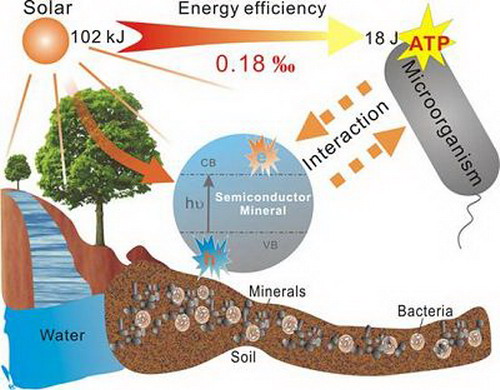
Illustration of semiconducting minerals mediating the growth of non-phototrophic microorganisms with solar energy in nature
It was believed that solar and chemicals are the two energy resources for all living organisms on Earth. Phototrophic microorganisms make use of solar energy for life, while non-phototrophic organisms obtain energy only through chemical reactions. Therefore the non-phototrophic organisms are excluded from the realm of the solar light-dependent metabolism, due to their lack of photosynthetic pigments.
The research team, made up of mineralogist, microbiologist, geologist and environmental scientists from many leading universities including Peking University and China University of Geosciences, attempted to find out whether non-phototrophic organisms could harness solar energy, directly or indirectly.
“As one of our research focuses is on the interaction between minerals and microbes, we tried to investigate the role of semiconducting minerals in mediating the transfer of photoelectrons to bacteria,” said microbiologist Xiao-Lei Wu, Peking University College of Engineering professor and one of the article’s corresponding authors..
The experiment system they designed confirmed that visible light-excited photoelectrons from metal oxide, metal sulfide, and iron oxide supported and stimulated the growth of chemoautotrophic bacteria. They also found that the measured bacterial growth was dependent on light wavelength and intensity, and the growth pattern matched the light absorption spectra of the minerals. Furthermore, similar observations were obtained in a natural soil sample containing both bacteria and semiconducting minerals.
Professor Anhuai Lu from the School of Earth and Space Sciences, Peking University, is first co-author of the article. He said he believes that the study will change human understanding of microbial life on Earth and how they access and utilize energy. He added that this finding may have broad application prospects in new-type microbial culture, fermentation, biochemical technology and environmental biotechnology.
***
This work was supported by the National Basic Research Program of China (973 Program) and the National Natural Science Foundation of China.
Paper cited:Lu, A. et al. Growth of non-phototrophic microorganismsusing solar energy through mineral photocatalysis. Nat. Commun. 3:768doi: 10.1038/ncomms1768 (2012).