-
[ July 22, 2015]
Professor Haifeng Yu makes progress in the research of photoresponsive liquid crystal and micro/nano composite materials
-
Recently, the research team led by Professor Haifeng Yu from College of Engineering of Peking University has made an important progress in the photoresponsive liquid crystal and micro/nano composite materials. The results titled “Optical Pendulum Generator Based on Photomechanical Liquid-Crystalline Actuators” have been published in the famous journal ACS Applied Materials & Interfaces as one communication. Link to the paper http://pubs.acs.org/doi/abs/10.1021/acsami.5b01732
For converting light energy into electricity, optical pendulum generator was designed by combining photomechanical movement of liquid-crystalline actuator (LCA) with the Faraday's law of electromagnetic induction. Bilayer cantilever actuators were first fabricated with low-density polyethylene (LDPE) and LCA. Their photomechanical movement drove the attached copper coils to cut magnetic line of force generating electricity. The output electricity was proportional to the changing rate of the magnetic flux, which was greatly influenced by light intensity, film thickness and sample size. Continuously electrical output was also achieved. This simple strategy may expand applications of materials in capture and storage of light energy. This work would have significant impact on photomechanical materials in device applications for advanced functions.
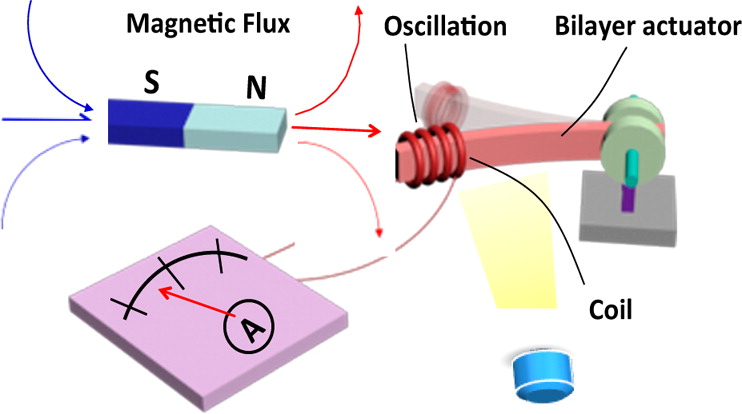
Figure shows photo-mechano-electronics based on photoresponsive liquid crystal and micro/nano composite materials.
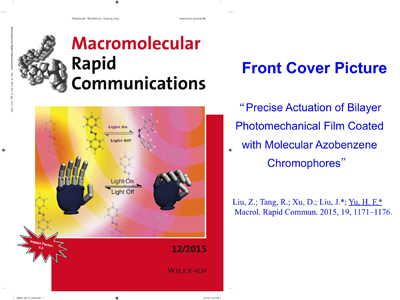
In another work, bilayer photomechanical films are fabricated by depositing one layer of molecular azobenzene chromophores onto flexible LDPE substrate. The photoinduced bending and unbending behaviors of five azobenzene derivatives were systematically studied by considering the incident light intensity and the thickness of coated chromophore layers. Precise control of photoinduced curling and unwinding motion of the bilayer film is successfully achieved upon irradiation with two UV light and thermal relaxations in the dark, respectively. The easily fabricated bilayer film shows fast photomechanical response, strong photoinduced stress and stability as that of crosslinked polymeric film. Due to its importance in the field of liquid crystal materials science and engineering, it has been selected as the front cover picture of this issue.