
-
[ June 30, 2015]
The Intelligence Control Lab studies leader-follower flocking of multiple robotic fish
-
Recently, Ph.D. student Yongnan Jia and Professor Long Wang from the Intelligence Control Lab, College of Engineering, Peking University has made research progress in the study of collective behaviors. Their paper “Leader–Follower Flocking of Multiple Robotic Fish” has been published on IEEE-ASME Transactions on Mechatronics in June 2015.
In recent years, flocking problem of a multi-agent system has become a subject of significant interest in the field of control theory, due to its potential application in mobile sensor network, multirobot systems, etc.
The team studied cohesive flocking and formation flocking of multiple robotic fish swimming in the water surface under the guidance of only one leader with zero-value external input. Combining consensus algorithms and attraction/repulsion functions, a distributed flocking algorithm is proposed for the robotic fish system to execute the cohesive flocking task.
According to the LaSalle-Krasovskii invariance principle, the proposed algorithm enables followers to asymptotically track the leader's velocity and approach the equilibrium distances with their neighbors, provided that the initial interaction network of the system is a leader-follower connected graph.
Furthermore, by adding the information of a desired formation topology to the potential function term, the proposed algorithm can be extended to solve arbitrarily shaped formation flocking problem of multiple robotic fish.
The experimental results demonstrate that the proposed approaches are effective for three robotic fish. Finally, several simulation examples are given to verify the functionality of the proposed approaches for a larger system with ten agents.
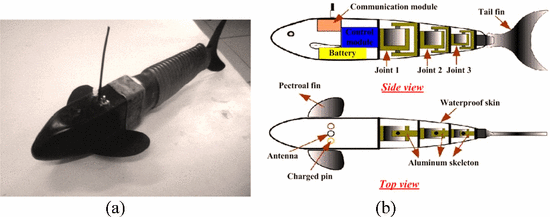
Multilink biomimetic robotic fish. (a) The prototype. (b) The side view and top view.