
-
[ November 14, 2015]
Professor Chao Zhou makes progress in the research of thermal performance of cavity tips in a transonic high pressure cascade
-
Recently, Professor Chao Zhou from the Department of Aeronautics and Astronautics, College of Engineering has made an important progress in the research of cavity tips of aero-engine turbines. The results titled “Effects of endwall motion on thermal performance of cavity tips with different squealer width and height” have been published in the journal “International Journal of Heat And Mass Transfer”.
http://www.sciencedirect.com/science/article/pii/S0017931015008194
In a high pressure turbine, tip clearances exist between the turbine rotor blade tip and the casing to prevent rubbing. The pressure difference between the blade pressure side and the suction side drives the high temperature gas across this tip clearance gap. This results in excessively high metal temperatures on the blade tip, which lead to thermal erosion and oxidation. The loss of the blade tip material increases the tip clearance gap, which reduces the efficiency and work output of the turbine. Therefore, obtaining good thermal performance of the blade tip is the key to maintain the performance of the gas turbine.
This work aims to understand the thermal performance of the cavity tip with relative endwall motion in a transonic high pressure turbine cascade. The effects of both squealer width and height on the flow physics, such as vortices within the tip cavity, are investigated.
Numerical methods were first validated and then used to investigate the thermal performance of cavity tips in a transonic high pressure turbine cascade. The effects of relative motion between the blade tip and the endwall on the flow within the tip cavity were studied.
It is found that a cavity scraping vortex forms within the tip cavity as the endwall moves relatively to the blade tip, which was not observed before.
It’s also found that the height of the squealer has a large effect on the flow physics within the tip cavity. When the squealer becomes higher, the size of the cavity vortex and cavity scraping vortex increases, and the size of the corner scraping vortex reduces.
The paper concludes that for the cavity tips studied in the current paper, the cavity tip with thin and low squealers produces the lowest loss.
The findings of current research will provide useful knowledge for the design of future cavity tips.
The research was supported by the National Natural Science Foundation of China (NSFC), Grant No. 11202008, and Aviation Industry Corporation of China.
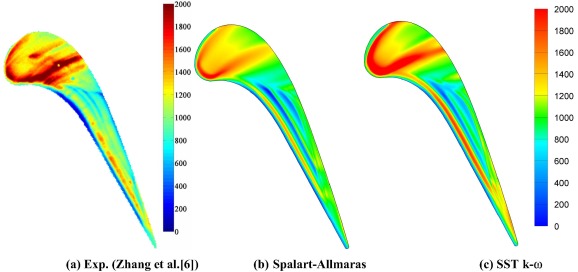
Fig. 4. CFD validation – heat transfer coefficient on the blade tip.