-
[ December 31, 2015]
Assistant Professor Yang Ding from the Beijing Computational Science Research Center gives an invited lecture on mechanics of swimming in sand
-
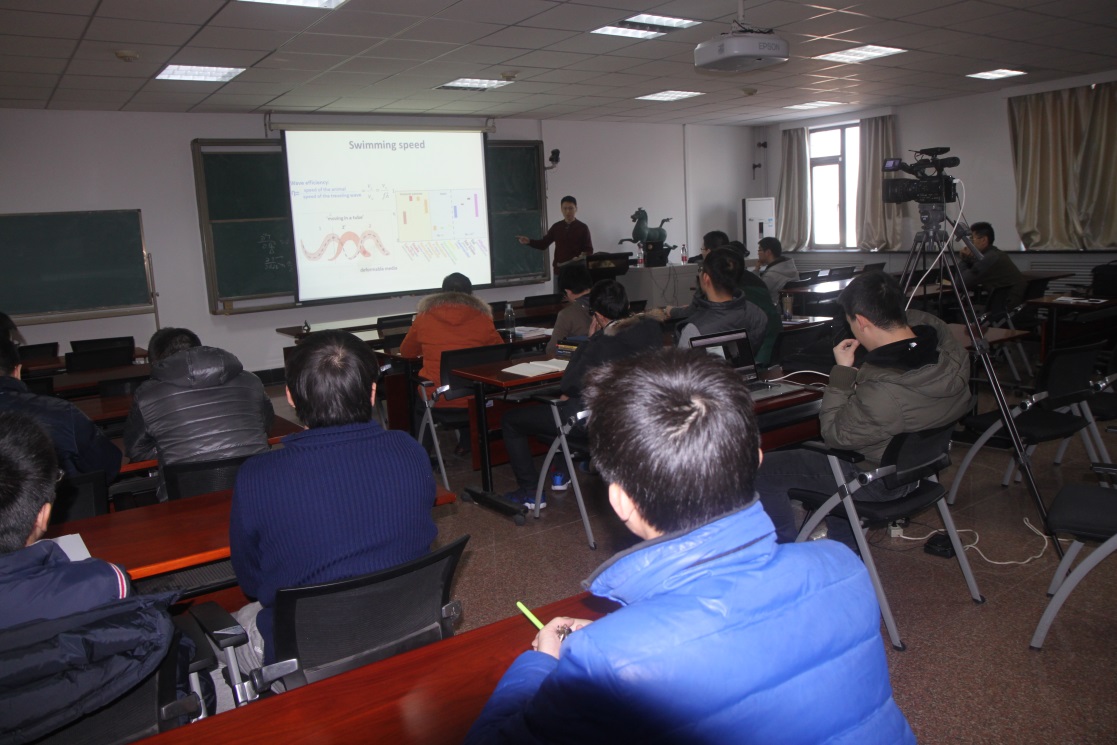
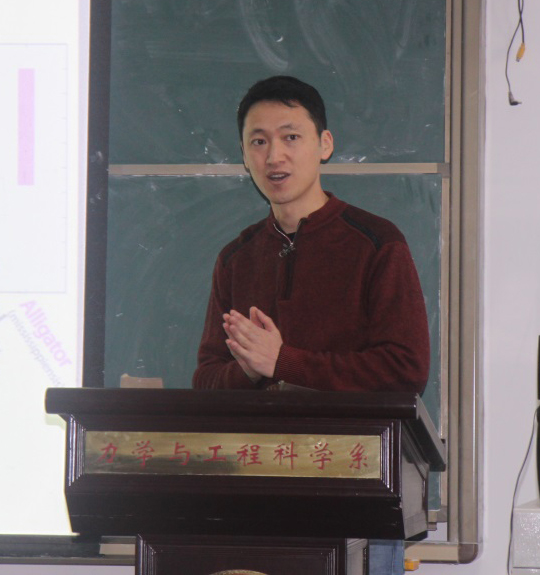 Invited by Prof. Guangming Xie of the Department of Industrial Engineering and Management, assistant professor Yang Ding gave an interesting lecture about the mechanics of swimming in sand to the College of Engineering students on December 28th. Many students attended the lecture.
Dr. Yang Ding received his Ph.D. in physics from Georgia Institute of Technology (GIT) in 2011. Afterwards, he did postdoctoral studies at Georgia Institute of Technology and University of Southern California. He joined the faculty of the Beijing Computational Science Research Center in 2014 and currently he is an assistant professor. He has publications in Science, PNAS, and PRL.
In the lecture, Dr. Ding began by talking about the amazing locomotive skills of animals like Jesus lizard, goat and sperm. He mentioned that as locomotion within granular media like sand, soil and debris that display both solid and fluid-like behavior is challenging and not well understood, the group he was in during his studies at GIT made efforts to understand the mechanics of swimming in sand by studying the swimming of 10 cm-long sandfish.
They used high speed x-ray imaging and showed that the sandfish swims at 2 body-lengths/sec within sand by propagating an undulatory traveling wave down the body. They developed an empirical resistive force model and detailed computational models. The models correctly predict the animal swimming speed and also explain the muscle activation pattern observed on the sandfish. The principles discovered helped the development of a sand-swimming robot.
The audience was very interested in the study. They raised many questions such as the experiment details, the simulation tools used, the manufacture of the robot, and how to choose research topics. And Dr. Ding answered them accordingly.