
-
[ December 29, 2015]
Progress made in two-dimensional anode materials for lithium-ion battery
-
Recently, a new progress in two-dimensional (2D) anode materials for lithium-ion battery has been made by Prof. Qian Wang’s group at the Center for Applied Physics and Technology (CAPT), College of Engineering, Peking University. They simulated a new type of metal-carbon-based sheet composed of transition metal centers and C2 dimers, and demonstrated that the TiC2 sheet has excellent Li storage capacity with a small migration barrier, a lower mass density compared with standard MXenes, and better chemical stability as compared to the MXene Ti2C sheet. Thus, the newly designed TiC2 sheet can be considered a promising anode material for lithium-ion battery. This work has been recently published in Nanoscale, entitled “ TiC2: A New Two-Dimensional Sheet beyond MXenes ”, and featured on the front outside cover of Nanoscale.
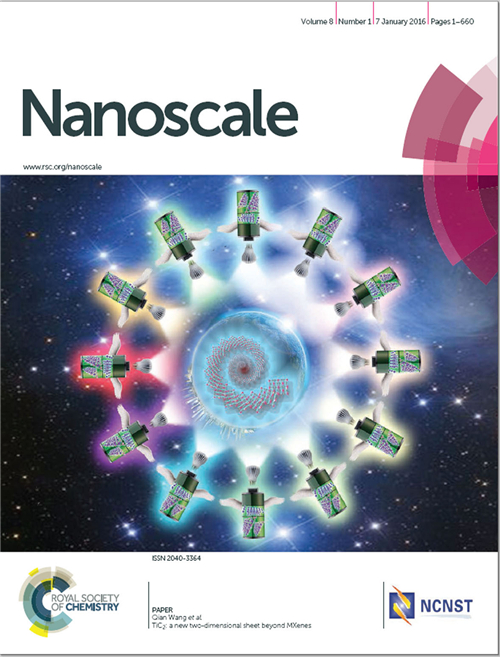
With the growing environmental crisis caused by fossil fuel, developing new clean energy resources is highly desirable. Lithium-ion battery is well-known for its high energy conversion efficiency and commercial application in portable electronic devices. However, the storage capacity of lithium-ion battery anode has become a bottleneck which limits its future application in vehicles or even larger equipment. Finding better alternatives for lithium-ion battery anodes has attracted considerable attention in materials science. Carbon-based materials such as graphene have shown superiority as lithium-ion battery anode materials as they show good resistance against erosion from acid and alkaline electrolyte. However, graphene-based structures have few lithium adsorption sites. Although previously synthesized MXenes have more lithium adsorption sites, the high mass results in low energy density. On the other hand, C2 dimer is the basic structural unit in the growth of many carbon structures and compounds such as metallocarbohedrenes (Met-Cars) MmCn, and plays a key role in its stabilization. Despite the versatility of C2 dimer in forming diverse structures, there has been no report to date on a 2D crystal that consists of transition metal atoms and C2 dimers. Thus, a comprehensive theoretical study was carried out for a 2D sheet composed of transition metal centers and C2 dimers by taking the Ti system as an example.
The calculated results reveal that the TiC2 sheet is not only stable dynamically and thermally, but also it is metallic with outstanding Li storage capacity beyond existing MXene Ti2C layers. Compared with commercial lithium-ion battery anode materials, TiC2 has an extraordinarily high capacity to accommodate and transport lithium ions. The Li storage capacity of TiC2 is three times of that of commercial anode material TiO2, while the diffusion energy barrier of lithium ions on TiC2 surface is only one third of that of TiO?2. The estimated open circuit voltage is comparable to that of graphene. All these outstanding electrochemical properties enable the TiC2 sheet as a potential novel anode material for lithium-ion battery.
The first author of this paper is Mr. Tianshan Zhao, a PhD student in Prof. Qian Wang’s group, and the corresponding author is Prof. Qian Wang at the CAPT. This work was supported by grants from the National Natural Science Foundation of China, the National Grand Fundamental Research 973 Program of China, and the Doctoral Program of Higher Education of China.