-
[ June 06, 2015]
Dr. Zhichuan Xu from Nanyang Technological University gave a seminar in COE
-
On May 29, invited by professor Yanglong Hou of COE Peking University, Dr. Zhichuan Xu who works in Nanyang Technological University gave a seminar entitled "Transition metal oxide materials for energy applications" at room 2-401 Liao Kai Yuan Building, Peking University. Prof. Yanglong Hou hosted this event.
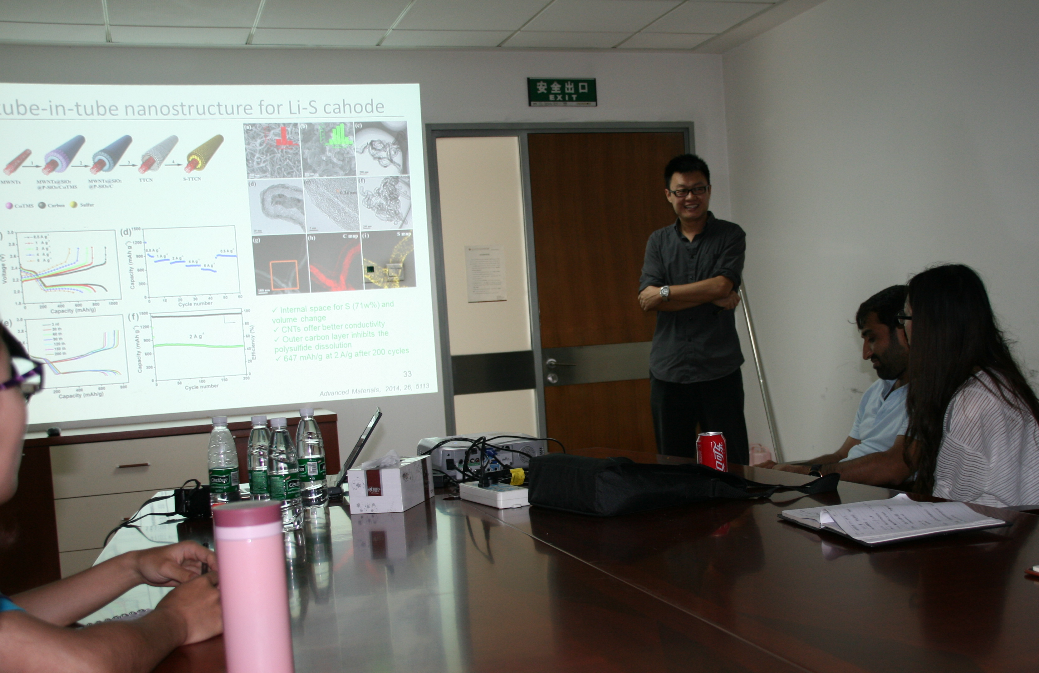
During this talk, Dr. Zhichuan Xu introduced recent progress on transition metal oxide materials for electrocatalysis and batteries. The first example was the synthesis of ultrathin MnO2 nanoflakes. They found that CTAB can be a very effective surfactant for controlling MnO2 particle size. The ultrathin flakes service well as the ORR catalysts when supported on carbon. They gave a high mass efficiency as compared to all other similar materials. These flakes can also serve as the standard active materials for making different MnO2/C supercapacitors with different carbons. They were able to compare these carbons and found that the carbon supports indeed affect the capacitance contribution from the active MnO2 material. In addition, the microstructure design of several electrode materials for Li-S, Li-ion, and Na-ion batteries has been discussed as well. The first example was a tube-in-tube carbon structure for incorporating S. The structure was able to offer a high S loading and stable performance. The outer carbon layer prevents the dissolution of S into the electrolyte. The structure is further modified with reserved interior void space to accommodate the large volume expansion of metal oxide anodes, such as SnO and Fe2O3, during cycling of conversion reactions with Li and Na. In addition, we also employed the in-situ X-ray absorption near edge spectroscopic (XANES) approaches to investigate the conversion reaction of FeOOH with Li. The approach can be extended to investigate the reaction of FeOOH with Na as well.
Dr. Zhichuan Xu is currently an assistant professor in the School of Materials Science and Engineering at Nanyang Technological University. Dr. Xu received his PhD training from Lanzhou University, Institute of Physics, CAS, and Brown University (2002-2008). His PhD study focused on nanomaterials synthesis and characterizations. He worked in State University of New York at Binghamton as a Research Associate (2007-2009) and then he worked in Massachusetts Institute of Technology as a Postdoctoral Researcher (2009-2012). Dr. Xu's research interests include electrochemistry, catalysis, solar fuels, energy storage, magnetic nanomaterials, and sensors.