
-
[ July 10, 2015]
Professor Faxin Li’ group makes progress in the research of electromechanical impedance method
-
Recently, Professor Faxin Li’s group from the Department of Mechanics and Engineering Science, College of Engineering has made an important progress in electromechanical impedance method. The paper titled “Quantitative electromechanical impedance method for nondestructive testing based on a piezoelectric bimorph cantilever” has been published in the famous journal “Smart materials and structures”. (http://iopscience.iop.org/0964-1726/24/6/065038/)
Impendence is one of the most important properties for electromechanical systems as the impendence directly relates to the internal compositions of materials. Recently, the electromechanical impedance (EMI) method has been intensively investigated for applications in nondestructive testing (NDT) and structure health monitoring (SHM). The EMI method is widely used as a qualitative method as exactly mechanical models were not available now due to the unreliable boundary. Therefore, engineers could not tell the defects type or damage degree.
Enlightened by the Atomic Force Microscopy, Prof. Li proposed a quantitative EMI method based on a piezoelectric bimorph cantilever. Here the sample’s local contact stiffness (LCS) was used as the identification parameter for NDT. Based on the equivalent circuit theory, the LCS can be quantitatively derived from the bimorph’s impendence frequency sweeping curves. A LabVIEW based NDT system was assembled and experimental results showed that the defects can be well reproduced. Both the defect type and the damage degree can be obtained from the LCS image. The proposed quantitative EMI holds great promise for NDT as well as health diagnose for tumors such as breast cancer.
This work was supported by the National Natural Science Foundation of China.
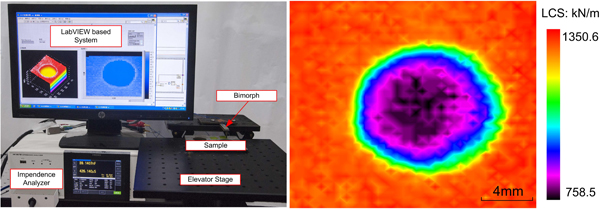
Photograph of the quantitative NDT system and a typical NDT result of an inside hole.