
-
[ March 06, 2015]
Xiaowei Zhan group achieved new advances in fullerene-free organic solar cells
-
 Recently, organic solar cells (OSCs) have attracted much attention due to their unique advantages such as low cost, flexibility, light weight, and large-area device fabrication. In 2015, Zhan group has achieved new advances in fullerene-free OSCs.
Fullerenes and their derivatives have been the dominant electron–acceptor materials in OSCs. However, the need remains to develop non-fullerene electron acceptors that will not only retain the favorable properties of fullerenes, but can also overcome their insufficiencies, such as their weak absorption in the visible spectral region, the limited spectral breadth, and limited energy-level variability. OSCs based on non-fullerene acceptors exhibit much lower PCEs than their fullerene counterparts. Development of high-performance non-fullerene acceptors is a challenging task.
In 2014, Zhan group achieved a series of advances in perylene diimide (PDI)-based nonfullerene acceptors. They fabricated all-polymer solar cells (all-PSCs) consisting of low-bandgap polymer donor PBDTTT-C-T and low-bandgap PDI-based polymer acceptor PPDIDTT. Binary additives synergistically boosted the power conversion efficiency (PCE) of all-PSCs up to 3.45% (Energy Environ. Sci., 2014, 7, 1351-1356, Front Cover, ESI Hot Paper, ESI Highly Cited Paper). Furthermore, they designed and synthesized a novel 3D, star-shaped nonfullerene acceptor (S(TPA-PDI)) based on PDI. Solution-processed OSCs based on PBDTTT-C-T: S(TPA-PDI) showed a PCE as high as 3.32% (Adv. Mater., 2014, 26, 5137–5142, Back Cover, ESI Hot Paper, ESI Highly Cited Paper). Solution-processed small molecule OSCs based on a twisted dimeric PDI acceptor showed a PCE as high as 3.12% (Adv. Energy Mater., 2014, 4, 1400420).
In 2015, Zhan group reported novel electron acceptors based on bulky fused-ring core (indacenodithiophene, indacenodithieno[3,2-b]thiophene), end-capped with 2-(3-oxo-2,3-dihydroinden-1-ylidene) malononitrile groups (Adv. Mater., 2015, 27, 1170–1174; Energy Environ. Sci., 2015, 8, 610-616). PSCs based on blends of the widely used polymer donor PTB7-TH and these acceptors exhibited PCEs up to 6.8% without any posttreatment, which is a new record for fullerene-free PSCs. The PTB7-TH: ITIC-based PSCs exhibited even better performance than the control devices based on PTB7-TH: PCBM.
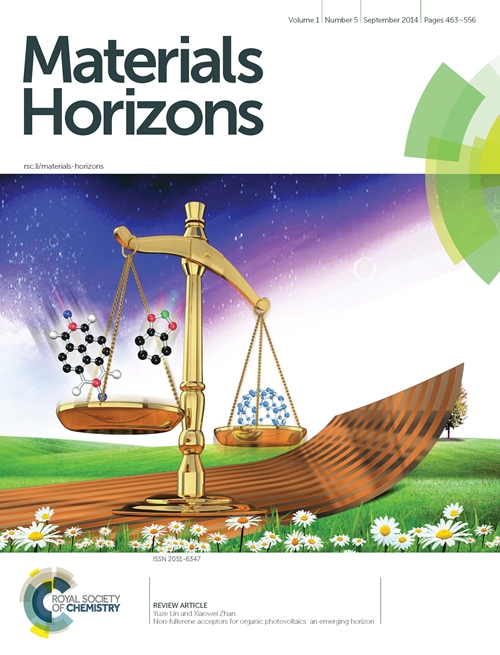
Zhan group published an invited review “Non-fullerene acceptors for organic photovoltaics: an emerging horizon” in Mater. Horiz. (2014, 1, 470-488), which was highlighted as Front Cover.
This search work was supported by the National Nature Science Foundation of China, Ministry of Science and Technology of China and Chinese Academy of Sciences.