
-
[ Janurary 10, 2015]
Professor Kaixin Liu’s group makes progress in the study of hidden orders in metallic glasses
-
Recently, Professor Kaixin Liu’s group from Department of Mechanics and Engineering Science, College of Engineering, has achieved great progress in the research of the atomic structures of metallic glasses. Metallic glasses are amorphous in the absence of long-range atomic packing orders, but their medium-range order may not be completely lost. Here, Liu et al. identify a number of crystalline units that are entangled in medium range and their influence on the glass forming ability in metallic glasses. The research paper has been published online in Nature Communications (Hidden topological order and its correlation with glass-forming ability in metallic glasses. Nat. Commun. 6:6035 doi: 10.1038/ncomms7035 (2015).)
http://www.nature.com/ncomms/2015/150112/ncomms7035/full/ncomms7035.html
The inherent atomic packing modes of glassy solids remain one of the most interesting and fundamental problems in condensed-matter physics and materials science. Although significant progress has been made and provided insights into the atomic-level structure and short-to-medium-range order in glasses, the way of leading to the medium-range order is still unclear.
Based on molecular dynamics simulations, the group’s work demonstrates that the medium-range atomic packing orders in metallic glasses which are hidden in the diffraction data in terms of structure factors or pair correlation functions. The analysis of the hidden orders in various metallic glasses indicates that the glassy and crystalline solids share a nontrivial structural homology in short-to-medium range, and the hidden orders are formulated by inheriting partial crystalline orders during glass formation. As the number of chemical components increases, more hidden orders are often developed in a metallic glass and entangled topologically. This phenomenon can be used to explain the geometric frustration in glass formation and the glass-forming ability of metallic alloys.
The first author of the paper is PhD student Zhenwei Wu from Professor Liu’s group. This paper is supported by National Science Foundation of China, the MOST Project of China, and the funding from State Key Laboratory for Turbulence and Complex Systems (LTCS).
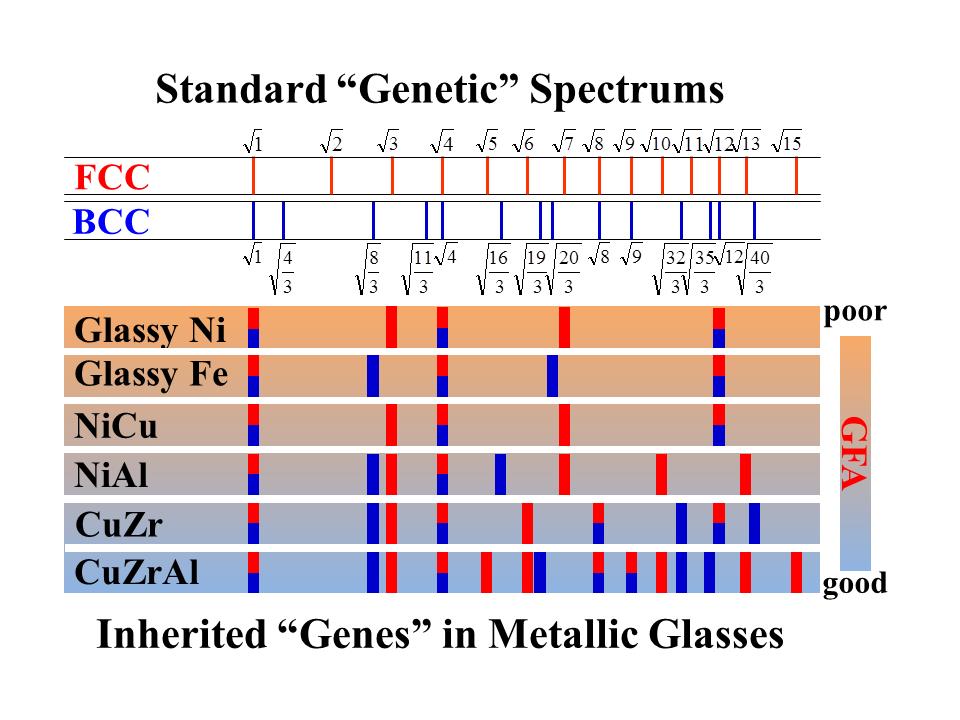
(Hidden orders in metallic glasses and its correlation with glass-forming ability)