
-
[ December 27, 2014]
Lightweight and high-strength ZrO2 ceramic corrugated core sandwich panels achieved
-
Recently, the research team led by Prof. Daining Fang and Yongmao Pei of the State Key Lab for Turbulence & Complex Systems, in corporation with School of Civil Engineering of Beijing Jiaotong University, has prepared ZrO2 ceramic corrugated core sandwich panels that achieved light weight and high strength. Their paper entitled “Fabrication and mechanical properties of lightweight ZrO2 ceramic corrugated core sandwich panels” has been published on Materials & Design in December 2014.
http://www.sciencedirect.com/science/article/pii/S0261306914005706ZrO2 ceramics have attracted much attention because of their high melting point and stability, high mechanical properties, and good insulation and erosion resistance for structural and functional applications, such as ceramic filters, catalysts support, and lightweight parts used at high temperatures. However, in some situations, the relatively high densities of ZrO2 ceramics limit their engineering applications. Till now, there have been long-standing efforts to create ceramics with low density but high strength. It is interesting to note that sandwich structures can not only ensure low density but also maintain high specific strength and stiffness.
Among all sandwich structures, corrugated core sandwich structure is one of the most promising alternatives which plays increasingly important role in many industrial areas, including lightweight aircrafts, transport vehicles and civil engineering. In previous works, metallic, and fiber reinforced composites based corrugated core sandwich panels have been intensively studied, however, there have been nearly no report about ceramic corrugated core sandwich panels. The problems currently existed in ceramic corrugated core sandwich panels include not only the fabrication methods but also the way investigating the mechanical properties.
In this paper, ZrO2 ceramic corrugated core sandwich panels were fabricated using a relatively simple gelcasting technique and pressureless sintering. And the mechanical properties, including three-point bending strength and compressive strength, were investigated and simulated.
The results showed that lightweight and high strength were realized through this sandwich structured design. Besides, the stress distribution in the ZrO2 ceramic corrugated core sandwich panel during the three-point bending and compression testing was simulated through finite element analysis (FEA). The researchers hoped that this study can give some ideas for sandwich structured ceramics with simultaneously low density and high strength.
This work was supported by the China Postdoctoral Science Foundation, the National Natural Science Foundation of China, and the National Basic Research Program of China.
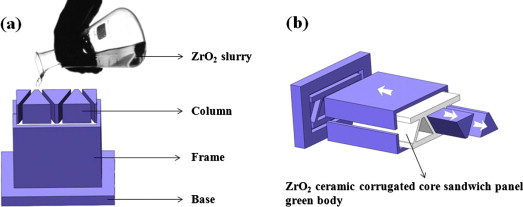
Fig. 1. The flow chart of the gelcasting process of the ZrO2 ceramic corrugated core sandwich panels: (a) gelcasting; and (b) demoulding.