
-
[ February 13, 2015]
High spatiotemporal super-resolution imaging achieved by Xi group in COE
-
Recently, a major progress was achieved by Peng Xi’s research team in the Department of Biomedical Engineering, College of Engineering (COE) in the development of joint tagging super-resolution fluctuation imaging (JT-SOFI). The paper is published on Scientific Reports under Nature Publishing Group. (Z. Zeng, et al., Fast Super-Resolution Imaging with Ultra-High Labeling Density Achieved by Joint Tagging Super-Resolution Optical Fluctuation Imaging. Sci. Rep., 5:8359 (2015).)
Link:http://www.nature.com/srep/2015/150210/srep08359/full/srep08359.html
Super-resolution microscopy has been awarded the 2014 Nobel Prize for Chemistry, as it can provide sub-diffractional resolution to the visualization of subcellular organelle. Although they can attain a high spatial resolution, it is always at a price of temporal resolution. Moreover, they are generally complicated in instrumentation with a high cost, which hinders their wide application.
In this work, researchers from Xi lab have utilized three techniques together: quantum dot (QD), spectrum isolation, and super-resolution optical fluctuation imaging (SOFI). Spatiotemporal resolution as high as 3 seconds and 85 nm are obtained with a conventional wide-field fluorescent microscope. With joint-tagging of multiple QDs at one subcellular target, the artefact of high-order SOFI can be largely suppressed, resulting in a high fidelity image reconstruction. Further, as the spectral isolated QDs are closer to single-molecule status, JT-SOFI can largely improve the temporal resolution of super-resolution imaging. It therefore provides a whole new technique for imaging the live cell with a highly dynamic environment at high spatiotemporal resolution.
The co-first authors of this paper are Zhiping Zeng and Xuanze Chen, and the corresponding author is Dr. Peng Xi. This work was supported by the National Instrument Development Special Program, the “973” Major State Basic Research Development Program of China, and the National Natural Science Foundation of China.
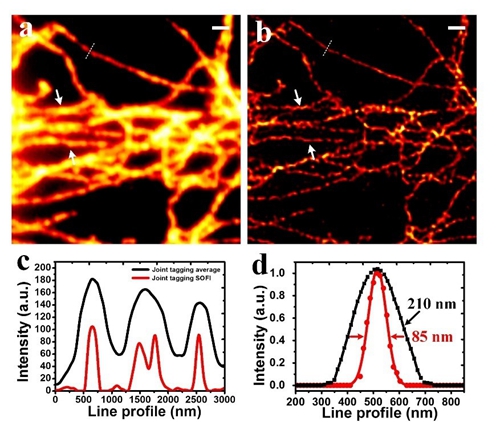
Figure 1 Comparison of the wide-field and JT-SOFI.