
-
[ December 15, 2014]
Dr. Liang Zhong from National Heart Center Singapore gave a seminar in the College of Engineering
-
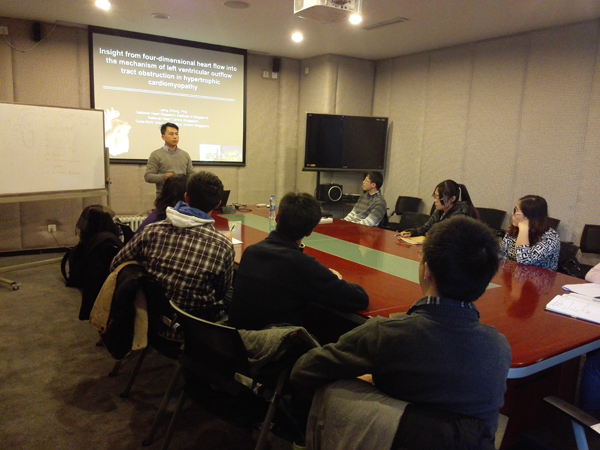
On December 12, 2014, invited by the Department of Mechanics and Engineering Sciences, Dr. Liang Zhong from National Heart Center Singapore (NHCS) gave a seminar entitled “Insight from four-dimensional heart flow into the mechanism of left ventricular outflow tract obstruction in hypertrophic cardiomyopathy” to the College of Engineering at Peking University. Associate Professor Ceji Fu hosted the event.
Starting from talking about Singapore’s demographic challenge, Zhong said the aim of the National Heart Research Institute Singapore (NHRIS) at NHCS where he works is to transform cardiovascular outcomes through patient-centred research.
He then introduced his research project on hypertrophic cardiomyopathy (HCM), which is a relative common genetic cardiac disorder which manifests through a thickening of the heart muscle. For the patients who do not respond to medication, surgical septal myomectomy (SSM) procedure may relieve the outflow obstruction. However, SSM is not always successful. Failure to alleviate obstruction frequently results from inadequate excision.
To address this problem, Zhong’s group is using Computational Fluid Dynamics (CFD) on heart blood flow to provide detailed hemodynamic information like 3-dimensional velocity profile and pressure gradient and vorticity formation. By comparing the vortex formation in HCM versus normal heart, the team hopes to understand the propensity to initiate, develop and maintain outflow obstruction. Further, the recognition of the flow pattern may lead to modification of surgical septal myectomy technique in HCM.
The students were very interested in the lecture, and discussed with Zhong on many questions, such as the symptoms and prevention of HCM and the CFD technique details.
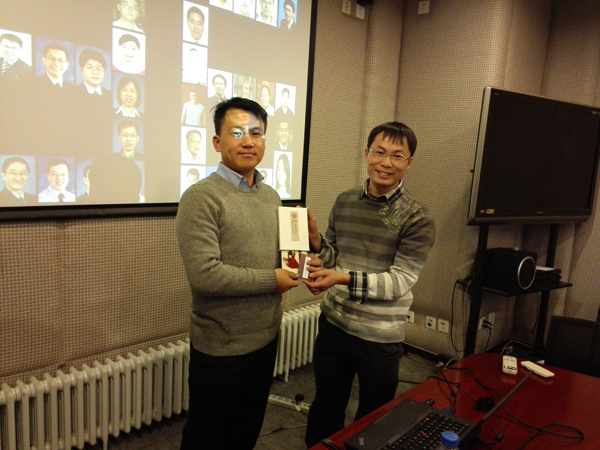
Dr. Liang Zhong, the invited speaker and Associate Professor Ceji Fu, the host