
-
[ March 03, 2015]
Professor Ruqiang Zou and co-workers achieve new progress in the research of covalent organic frameworks
-
Recently, the research team led by Professor Ruqiang Zou from the College of Engineering and co-workers from Singapore Peking University Research Centre for a Sustainable Low Carbon Future (SPURc) made an important progress in the study of covalent organic frameworks (COFs). Related paper “Covalent Organic Frameworks Formed with Two Types of Covalent Bonds Based on Orthogonal Reactions” has been published in Journal of the American Chemical Society (http://pubs.acs.org/doi/abs/10.1021/ja510926w).
As an emerging class of porous crystalline materials, covalent organic frameworks whose structures can be precisely predetermined by molecular building blocks using reticular chemistry exhibit periodic architectures, low densities, permanent porosity, readily functionalization and good thermal stability, rendering them good candidates for various potential applications in gas adsorption, optoelectronics, catalysis, separation, and proton conduction. However, all of the successful methods to construct COFs have only been limited to a few condensation reactions; moreover, the reported COFs were built by only one type of covalent bond formation.
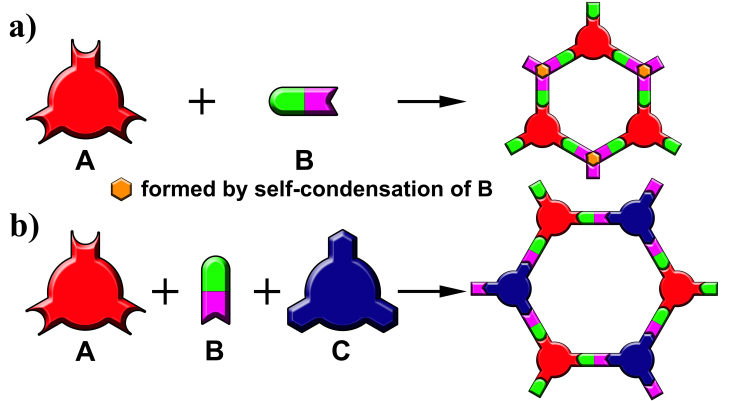
Professor Zou’s team put forward a new strategy. By using a novel orthogonal reaction strategy, they rationally designed and successfully constructed COFs with the formations of two types of covalent bonds in only single step. The protocol was applied to construct not only binary COF but also more complicated ternary COF. It is notable that the conventional step-by-step methods cannot be validated to the two COFs. The reaction mechanism for the formations of COFs was investigated and revealed the parallel formations of two types of bonds that be concurrently accompanied by the crystallization of COFs. This strategy presents a new idea for designing novel COFs and will broaden greatly the scope of the COFs materials.
Dr Yongfei Zeng, a research fellow in SPURc, is the first author of the paper. Professor Ruqiang Zou, The PI of SPURc, is the corresponding author, and the Co-PI Professor Yanli Zhao from Nanyang Technological University is the co-corresponding author of this paper.
In addition, some other important works from the same group in SPURc have also been published in famous international journals, such as “Selective adsorption of CO2/CH4 and CO2/N2 within a charged metal–organic framework” J. Mater. Chem. A 2014, 2, 17771-1777; “Click-extended nitrogen-rich meta–organic frameworks and their high performance in CO2-selective capture, Chem. Commun. 2014, 50, 4683-4685; “Fabrication of novel hybrid nanoflowers from boron nitride nanosheets and metal-organic frameworks: A solid acid catalyst with enhanced catalytic performance,” J. Mater. Chem. A 2014, 2, 18731-18735; “New challenge of metal–organic frameworks for high-efficient separation of hydrogen chloride toward clean hydrogen energy,” J. Mater. Chem. A, 2015, 3, 5275-5279. Recently, they also contributed a comprehensive review “Macrocycle-Based Metal-Organic Frameworks” (http://dx.doi.org/doi:10.1016/j.ccr.2015.02.012) for Coordination Chemistry Reviews.
These works are supported by Singapore-Peking University SPURc program and National Natural Science Foundation of China.