
-
[ Janurary 19, 2015]
Professor Lin Huang’s team wins the Most Influential Paper Award of the 30th Anniversary of journal “Control Theory & Applications”
-
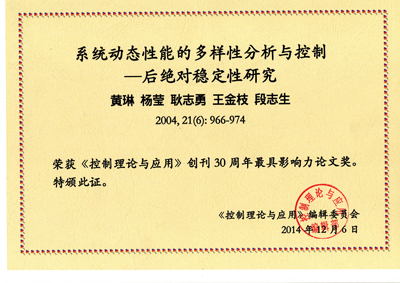 Recently, a paper of Professor Lin Huang from the Department of Mechanics and Engineering Science, College of Engineering at Peking University, won the Most Influential Paper Award of the journal ”Control Theory & Applications” in its history of 30 years. The paper is entitled “Analysis & control of diversity of system dynamic properties: on the post-absolute stability”. Link: http://jcta.alljournals.ac.cn/cta_cn/ch/reader/view_abstract.aspx?file_no=200406027&flag=1.
The main objective of control theory has long focused on the stability analysis of system equilibrium and stabilizing controller synthesis. But these can not meet the practical need anymore.
Prof. Lin Huang’ s team has been working on some dynamic properties different from the stability of the single equilibrium in recent years, including the boundedness of system trajectories (i.e. Lagrange stability), dichotomy, gradient-like behavior and the Bakaev stability (ensuring no transition of equilibria). Frequency-domain methods as well as linear matrix inequalities methods are established on how to design a feedback controller guaranteeing the above mentioned properties.
The paper also investigates the stability and control of periodic oscillations (the auto-oscillations and the forced oscillations) of high order systems. Recent developments on estimation of the Hausdorff dimension and the Lyapunov exponent of strange attractors are also introduced.
The paper points out that the related research has great significance in the field of control theory and should be a new direction in nonlinear control systems.
This study was funded by the National Natural Science Foundation. Other collaborators include Ying Yang, Zhiyong Geng, Jinzhi Wang, Zhisheng Duan from the Department of Mechanics and Engineering Science, College of Engineering, Peking University.