
-
[ October 28, 2014]
Professor Zhensu She elected as APS Fellow
-
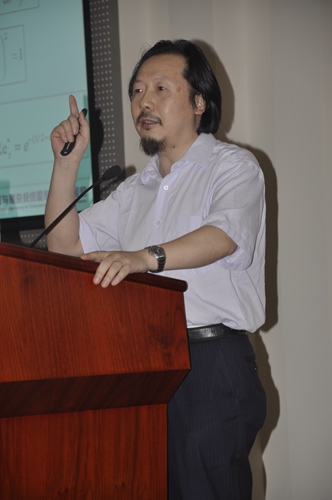 It is recently announced by the American Physical Society (APS) that Professor Zhensu She of College of Engineering at Peking University is elected as Fellow of 2014. The certificate will be delivered to Prof. She during the annual meeting of the APS Division of Fluid Dynamics (DFD) in San Francisco in November.
Prof. She obtained his Ph.D. from University of Paris 7 in 1987, under the supervision of Dr. Uriel Frisch, member of French National Academy of Science. Then, Prof. She had worked at Princeton University as a research associate and research staff, before joining the faculty at the University of Arizona as an associated professor in 1992. In 1995, he was appointed associate professor at the University of California at Los Angeles, and became full professor in 1997. In late 1998, he was appointed to be Zhou Peiyuan Professor of mechanics at Peking University, and director in the State Key Laboratory for Turbulence Research. Prof. She became a Sloan fellow in 1992, and obtained a Chinese Young Scientist Medal in 2003.
Prof. She specializes in theoretical study of turbulence. He has published over eighty articles, with over 3000 SCI citations. His most well-known work concerns the explanation of small-scale non-gaussian statistics and the development of a scaling model, known as She-Leveque (SL) model for describing scaling exponents of the high-order velocity structure functions (Leveque is his first graduate student). SL model is an elegant formula with no adjusting parameter, which describes accurately experimental and numerical observations. Since 1994, the SL model has received a wide attention from over 120 different journals and researchers from over 40 countries, and become a basic model to use in many areas of research, especially in astrophysics. In 2006, a Phys. Rev. Lett. article is entitled “Low-Redshift Cosmic Baryon Fluid on Large Scales and She-Leveque Universal Scaling”. Statistics show that the SL model is the most frequently cited paper in all “turbulence” papers published on the Phys. Rev. Lett. in recent several decades.
The citation for his fellowship reads: “For his contribution to the understanding of intermittency effects and non-Gaussian statistics of small-scale turbulent fluctuations, and quantification of the anomalous scaling of high order velocity structure functions”.
More recent work of Prof. She concerns another monumental theory of turbulence, namely the log law in wall turbulence. A structural ensemble dynamics (SED) theory has been proposed, which yields a full analytic solution of the mean velocity profile for channel, pipe and turbulent boundary layer, which extends the log law to cover the full domain, for the first time. A notable feature of SED is a new definition of the Karman constant, which turns out to be universal and equals 0.45. The new work is gradually attracting wide attention.
APS was born in 1899, and now has over 40,000 members. It is one of the most reputed physical societies in the world. Every year, APS elects less than 0.5% of its best members to be fellow. Its journal Phys. Rev. Lett. is considered to be the best physics journal worldwide.