
-
[ December 02, 2014]
Professor Hao Wang makes progress in the research of dynamic wetting
-
Professor Hao Wang from the Department of Energy and Resources Engineering, College of Engineering has made an important progress in dynamic wetting. The results titled “Convex Nanobending at a Moving Contact Line: The Missing Mesoscopic Link in Dynamic Wetting” have been published on line in the famous journal ACS Nano (IF 12).
http://cdn-pubs.acs.org/doi/full/10.1021/nn5046486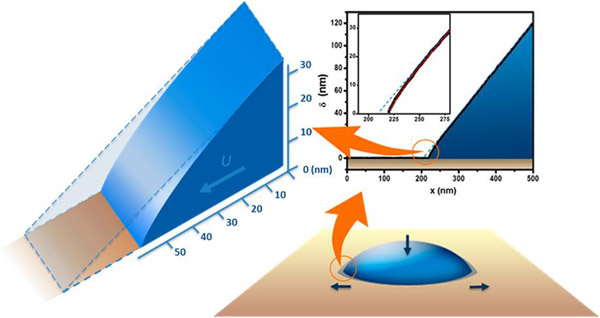
Dynamic wetting is ubiquitous in natural and man-made systems. It plays important roles in large scale systems such as deposition, coating, and oil recovery, and in small scale systems such as electronics cooling, micro and nano fluidics, self-assembly, friction and various biological processes. Being the junction of the triple-phase interfaces, the contact line is also a classical system for the study of long-range intermolecular forces which are of central roles in nanotechnology.
The morphological information on the very front of a spreading liquid is fundamental to our understanding of dynamic wetting. Debate has lasted for years concerning the nanoscopic local angles and the transition from them to the macroscopic counterpart, θD. This study of nonvolatile liquids analyzes the interface profile near the advancing contact line using an advanced atomic force microscopy. The interface is found following the macroscopic profile until bending in a convex profile around 20 nm from the substrate. This shoe-tip-like feature is common in partially wetting while absent for completely wetting, and its curvature varies with advancing speed.
The observation ends the long-standing debate about the nanoscopic contact angles and their speed dependency, paving the way to a comprehensive understanding of moving contact lines.
Prof. Hao Wang’s group (Lab of Heat and Mass Transfer at Micro-Nano Scale) focuses on heat and mass transfer at small scales, including phase-change heat transfer, Aerosol (PM 2.5) elimination, and thermophysics of bio cells.
Ph.D. student Lei Chen and Dr. Jiapeng Yu from Professor Wang’s lab are the co-first authors of the paper. Professor Wang is the corresponding author. This work was supported by the National Natural Science Foundation of China (No. 91334110).