-
[ October 08, 2014]
Professor Haifeng Yu makes a new progress in photo-driven materials
-
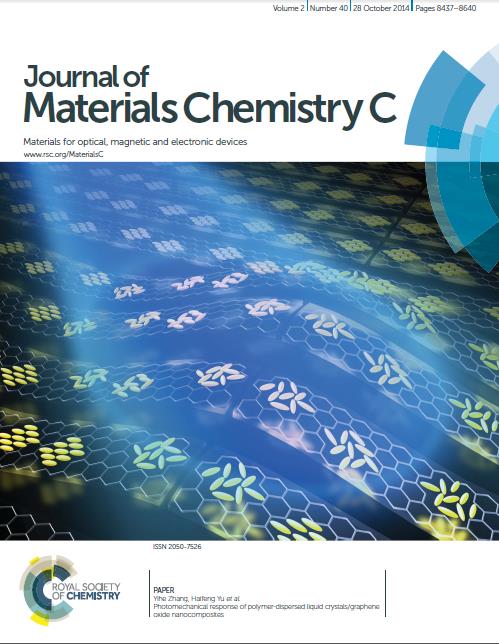 Recently, the research team led by Professor Haifeng Yu from College of engineering of Peking University has made an important progress in the liquid crystal and micro-nano composite material. The result titled “Photomechanical response of polymer-dispersed liquid crystals/graphene oxide nanocomposites” has been published and selected as cover picture in the famous journal “Journal of Materials Chemistry C”.
http://pubs.rsc.org/en/Content/ArticleLanding/2014/TC/c4tc01097cPhoto-driven liquid crystal and micro-nano composite material under external light stimulation can demonstrate controllable mechanical response, remote operation, the wireless drive, precise control and many other advantages, compared with other stimuli (eg: electricity, magnetism, temperature, etc.). For traditional photo-driven polymer materials, the driving force comes from the cis-trans isomerization of azobenzene chromophores under UV irradiation. But UV light damages polymer material itself and limits its application in biology and other fields. Therefore, the material response in the visible region can undoubtedly have great significance.
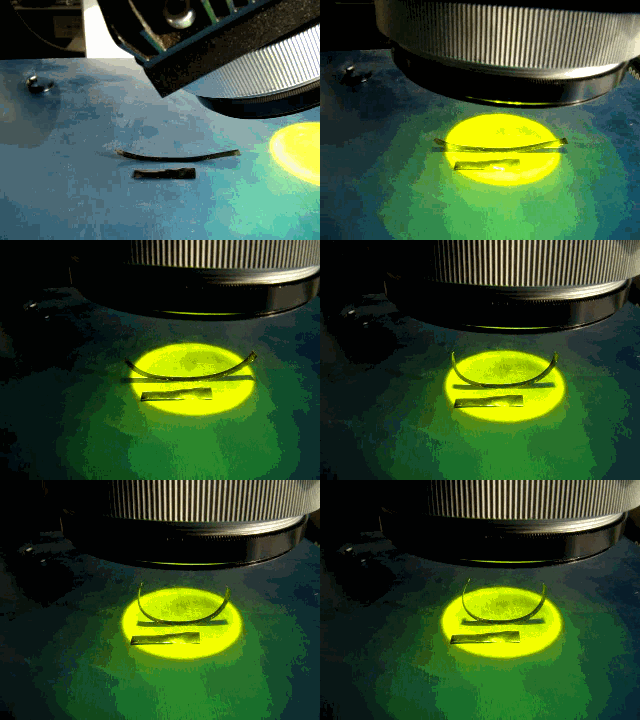
Prof. Yu’s group successfully fabricated recyclable, fast and visible-light responsive polymer-dispersed liquid crystal (PDLC)/graphene oxide (GO) nanocomposite films by a combination of solution casting and mechanical stretching. In the PDLC/GO nanocomposite films, one low-molecular-weight nematic LC (5CB) formed a separated phase and GO-dispersed polyvinyl alcohol (PVA) was used as the film matrix. Upon irradiation with visible light, PDLC/GO nanocomposite films showed photomechanical response, bending toward the light source along the stretching direction. Here, GO functioned as the light absorbent and nanoscale heat source to thermally induce a phase transition with 5CB from homogeneous alignment to an isotropic phase. Thus, volume contraction occurred on the surface area of the nanocomposite films due to the photothermal effect of GO, whereas little change took place in the opposite area, resulting in the visible light-induced photomechanical response in a bimetal-like mode. Accordingly, most of general polymer materials can be utilized to fabricate visible-light responsive PDLC/GO nanocomposite films. These nanocomposite films can be potentially used in soft actuators and micro-optomechanical systems with visible light as the energy source.
This work was funded by the National Natural Science Foundation of Outstanding Youth Fund, the Youth Fund and the China Postdoctoral Science Foundation, etc.