
-
[ July 15, 2014]
Prof. Qiushi Ren’s group makes important progress in the development of multi-modality molecular imaging system
-
Recently, the Journal of Nuclear medicine, a leading journal in the field of molecular imaging, published online the work from a group led by Dr. Qiushi Ren in the Biomedical Engineering Department (BME) of College of Engineering, Peking University.
Dr. Ren’s group developed the world first quad-modality molecular imaging system for small animal study, providing a fantastic platform for various biomedical research, including drug discovery and disease study. This work, titled as “An Integrated Quad-modality Molecular Imaging System for Small Animal” is available online (URL of the article: http://jnm.snmjournals.org/content/early/2014/06/19/jnumed.113.134890).
By enabling the visualization of the physiological and pathological processes at the cellular and molecular level in living organisms, molecular imaging has already become a key method to study and diagnosis of diseases, such as cancer, neurological and cardiovascular diseases. Several molecular imaging modalities, including Positron Emission Tomography (PET), Single Photon Emission Computed Tomography (SPECT) and Fluorescence Molecular Imaging (FMI), are widely used in the research and clinical applications. However, it is desired to use multiple molecular imaging methods to trace and monitor multiple molecular targets to study the complicated life phenomena. However, most current imaging systems are single modality or dual modalities, which could not meet the increasing demand in the field of biomedical research and clinical imaging.
Supported by the National Key Instrumentation Development Project, Dr. Ren’s group and their collaborators developed a novel quad-modality molecular imaging system which includes all three major molecular imaging modalities of PET, SPECT and FMI, as well as an X-ray computed tomography (CT) system to provide the anatomical information, which could greatly help researchers to obtain multiple complementary biochemical information for biomedical and pre-clinical study.
The first author of this work is a PhD student in BME, the corresponding authors are Dr. Qiushi Ren and Dr. Changhui Li. The major collaborators are Associate Prof. Kun Yang at Hebei University, Prof. Hongbin Han at Medical School of Peking University and Prof. Jiahe Tian at the Department of Nuclear Medicine, the General Hospital of the People's Liberation Army.
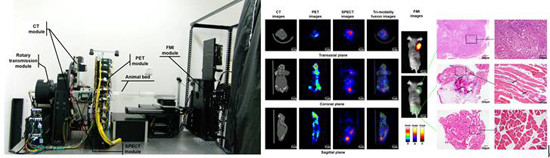
Quad-modality hybrid imaging system and small animal imaging study